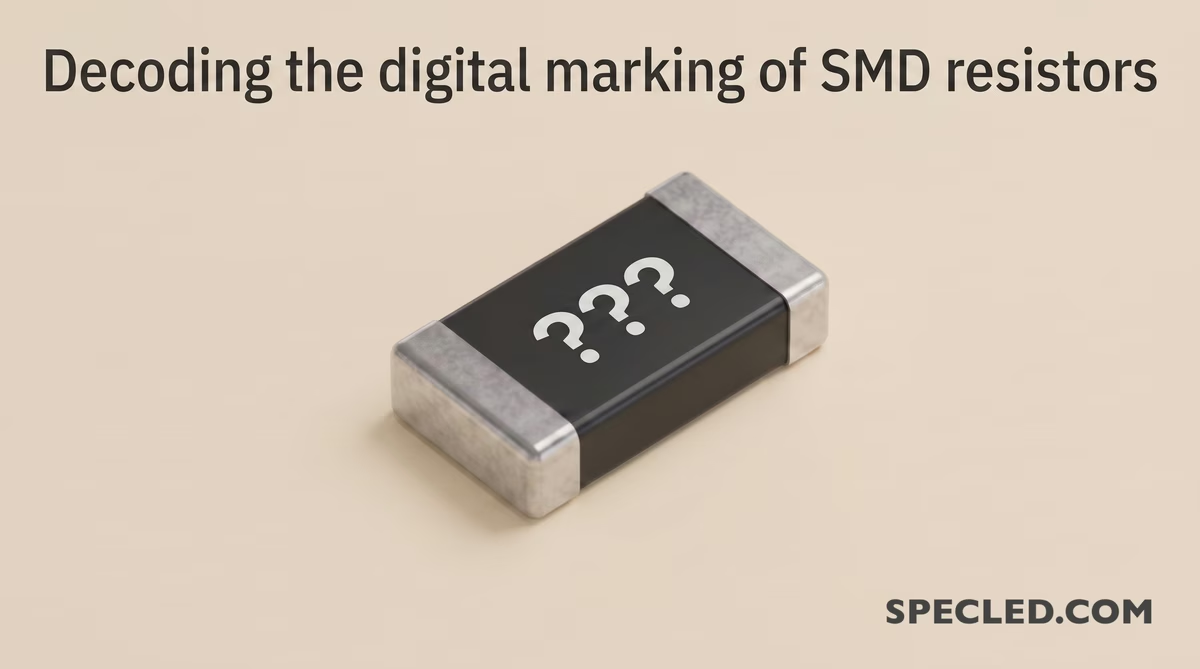
Modern electronics are constantly striving for miniaturization. If you have ever seen the inside of a smartphone, a computer motherboard, or an automotive control unit, you have likely noticed tiny rectangular components densely populating the printed circuit board. These are Surface Mount Devices (SMD), with resistors and capacitors being the most common among them.
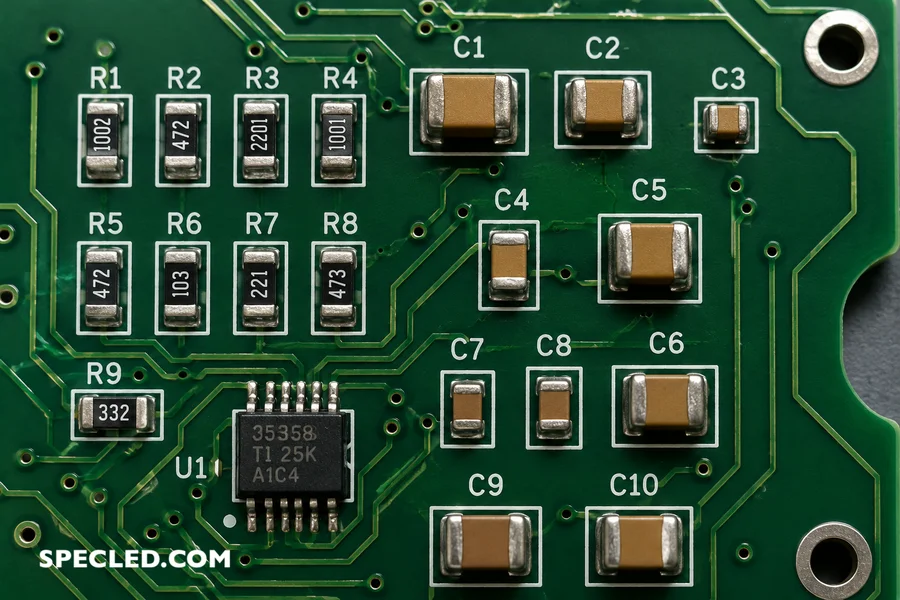
A frequent challenge when working with such microscopic parts is determining their exact value. While through-hole components traditionally use resistor color codes↗ with painted bands, placing stripes on tiny chips is technologically impractical. Therefore, a specific alphanumeric coding system was developed. In this article, we will break down exactly how standard markings work, how to identify physical dimensions and power ratings, and why our smd resistor code calculator will become your indispensable assistant for electronics repair and design.
How Does SMD Resistor Marking Work?
At first glance, the sequence of numbers and letters on a black component body might look confusing. However, standard smd resistor marking follows strict international guidelines. To avoid wasting time on manual calculations and multiplier errors, engineers frequently use our convenient online tool to decode these values. Let's review the main coding systems you will encounter in practice.
3- and 4-Digit SMD Resistor Marking
The most common way to indicate a nominal value is by using three or four digits. The logic here is straightforward and resembles the classic color coding, but using actual numbers instead of colors.
Three-digit marking (standard 5% tolerance): The first two digits represent the significant figures (the mantissa), and the third digit is the multiplier (the power of ten, or simply the number of zeros to add). For example, if you enter the code 103 into our resistor code calculator, it will instantly show a resistance of 10 kΩ with a ±5% tolerance. Mathematically, this looks like: 10 * 10³ = 10,000 Ohms = 10 kΩ.
Four-digit marking (high precision 1%): In more precise circuits, resistors with a 1% tolerance are used. Four digits are used to code them. The principle remains the same, but the mantissa now consists of three digits, with the fourth acting as the multiplier. For instance, the code 4702 means: 470 * 10² = 47,000 Ohms = 47 kΩ (with 1% precision).
Important note: If the resistance is less than 10 Ohms, the letter "R" appears in the marking, acting as a decimal point. Thus, 4R7 means 4.7 Ohms, and 0R22 stands for 0.22 Ohms.
EIA 96 Resistor Code: Advanced SMD Resistor Marking
As component dimensions continued to shrink (down to the 0603 package size and smaller), printing four digits became physically impossible—they simply couldn't be read, even under a microscope. To solve this problem, the EIA-96 standard was introduced, which is fully supported by our calculator.
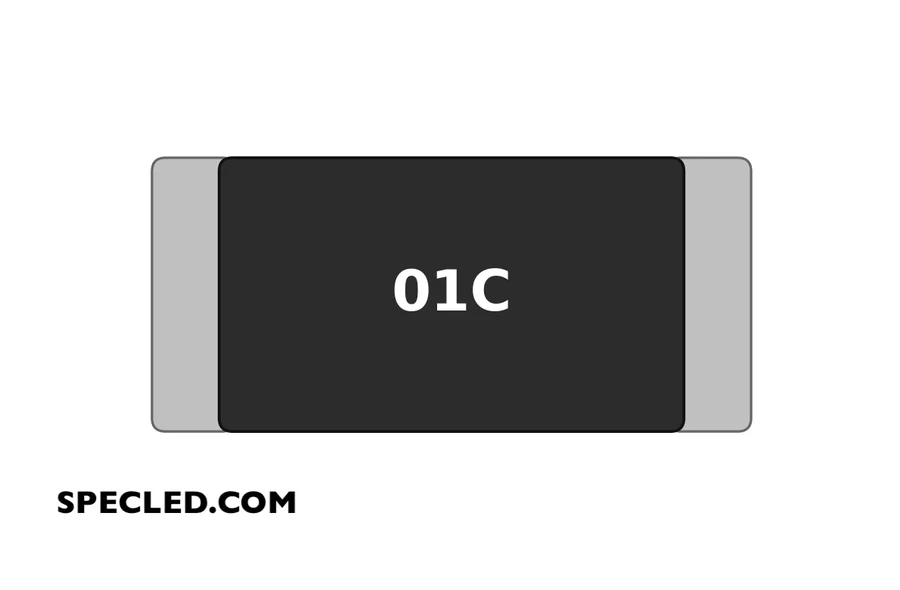
An EIA 96 resistor code always consists of three characters: two numbers and one letter at the end (for example, 01C or 68X).
- The first two digits are not the actual resistance, but a specific code from the EIA-96 lookup table pointing to a three-digit base value.
- The final letter is the multiplier (e.g., Y = 10⁻², X = 10⁻¹, A = 1, B = 10, C = 100, and so on).
Memorizing the 96-position EIA-96 table and letter multipliers is virtually impossible. This is why using a dedicated widget drastically speeds up the process of identifying parts on a PCB.
Physical Dimensions: SMD 0805 Size, SMD 1206 Size, and More
Besides electrical resistance, a crucial parameter is the physical package size. In datasheets, SMD component sizes are most often indicated in the imperial (inch) system, though metric equivalents exist.
Our widget features a convenient "Package Size" dropdown menu where you can select the desired package, such as the smd 1206 size or smd 0805 size, and instantly see its physical parameters in millimeters (e.g., 3.2 x 1.6 MM). To make PCB routing or soldering easier for you, we have prepared a reference table.
This table outlines the main SMD package sizes and their exact physical dimensions:
| Package Size (Imperial) | Package Size (Metric) | Length x Width (mm) | Practical Application |
|---|---|---|---|
| 01005 | 0402 | 0.4 x 0.2 | Smartphones, wearable tech. Machine soldering only. |
| 0201 | 0603 | 0.6 x 0.3 | Modern mobile devices, compact modules. Machine soldering only. |
| 0402 | 1005 | 1.0 x 0.5 | Tablets, laptops. Hand soldering requires skill and a microscope. |
| 0603 | 1608 | 1.6 x 0.8 | The standard for most modern consumer electronics. |
| 0805 | 2012 | 2.0 x 1.25 | Perfect balance for DIY projects. Relatively easy to solder by hand. |
| 1206 | 3216 | 3.2 x 1.6 | Industrial electronics, power supplies. Very convenient for beginners. |
| 1210 | 3225 | 3.2 x 2.5 | Power circuits with increased power requirements. |
| 2010 | 5025 | 5.0 x 2.5 | Power management circuitry. |
| 2512 | 6432 | 6.3 x 3.2 | High-power current shunts and power supply circuits. |
As the table demonstrates, SMD sizes are highly diverse. Choosing a specific package during device design is always a compromise between PCB mounting density and the heat the component must dissipate during operation.
Power Ratings: SMD Resistor 0805 Power vs SMD Resistor 1206 Power Explained
Every SMD resistor generates heat as electrical current passes through it. If the amount of generated heat exceeds the package's ability to dissipate it, the resistor will overheat, drift from its nominal value, or simply burn out, breaking the circuit. The physics here are simple: the larger the surface area (and correspondingly, the package size), the more heat the part can safely transfer to the surrounding environment and the PCB.
Our smd resistor code calculator automatically outputs this parameter. For example, by selecting the 2512 package, you will see its nominal power dissipation is 1W.
A common task involves LED resistor calculation↗, such as for an indicator light. The need for this calculation frequently arises among DIY enthusiasts, hobbyists, and those just starting their journey in electronics. It is exactly for them that we developed our resistor value calculator.
Need to calculate resistance and power for resistors connected in series and parallel↗? We have an interactive calculator.
SMD Resistor 0805 Power vs SMD Resistor 1206 Power: Common Questions
Let's look at the two most popular sizes among developers and DIY enthusiasts:
- SMD resistor 0805 power: Resistors in the 0805 package typically have a nominal power rating of 0.125W (or 1/8W). This is more than sufficient for microcontroller logic level pull-ups/pull-downs, signal lines, LED indicators, and most low-power digital circuits.
- SMD resistor 1206 power: The 1206 package is larger, and its standard power rating increases to 0.25W (1/4W). These components are utilized in circuits carrying higher currents, such as simple voltage dividers for analog sensors, transistor base circuits, or as ballast resistors.
Below is a summary table detailing the relationship between package size and nominal power:
| Package Size | Nominal Power Rating (Watts) |
|---|---|
| 0201 | 0.05 W (1/20 W) |
| 0402 | 0.063 W (1/16 W) |
| 0603 | 0.1 W (1/10 W) |
| 0805 | 0.125 W (1/8 W) |
| 1206 | 0.25 W (1/4 W) |
| 1210 | 0.5 W (1/2 W) |
| 2010 | 0.75 W (3/4 W) |
| 2512 | 1.0 W (1 W) |
Please note: These values are industry standards. There are specialized series of thick-film or wirewound SMD resistors capable of dissipating higher power within the same dimensions. However, for baseline calculations and standard repairs, you should rely on the standard values listed above.
Benefits of Using an Online SMD Resistor Code Calculator
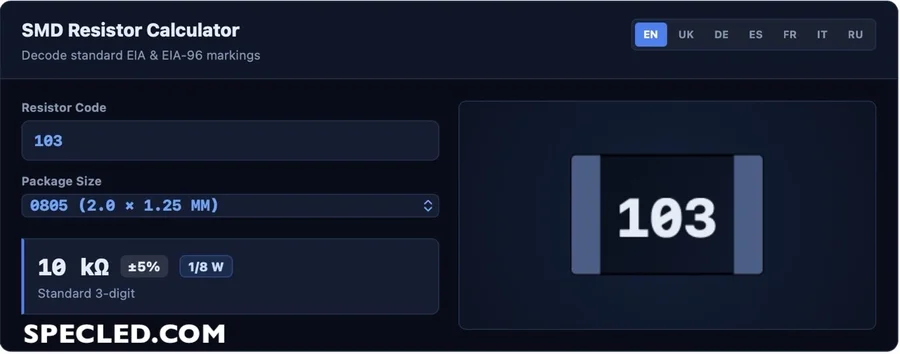
When repairing a motherboard or developing your own device, time is your most valuable resource. Calculating multipliers in your head, recalling the EIA-96 table, or keeping printed dimension cheat sheets nearby is highly inconvenient.
Our tool integrates everything you need into a simple, intuitive interface. You only need to enter the code printed on the component and select its physical package. The system will instantly provide the exact resistance, precision tolerance, and operating power. The interface is available in multiple languages—including English, Ukrainian, German, Spanish, French, Italian, and Russian—making it a universal solution for electronics professionals worldwide.
Our arsenal includes a variety of widgets, including calculators for electronics enthusiasts, such as a component calculator for a simple capacitive dropper power supply! I once faced the challenge of calculating the capacitance for a basic low-power LED driver. Unable to find a reliable capacitive dropper calculator↗ at the time, I had to do the math on a piece of paper. Now, many years later, I have solved this problem and am thrilled to make this calculator publicly available.