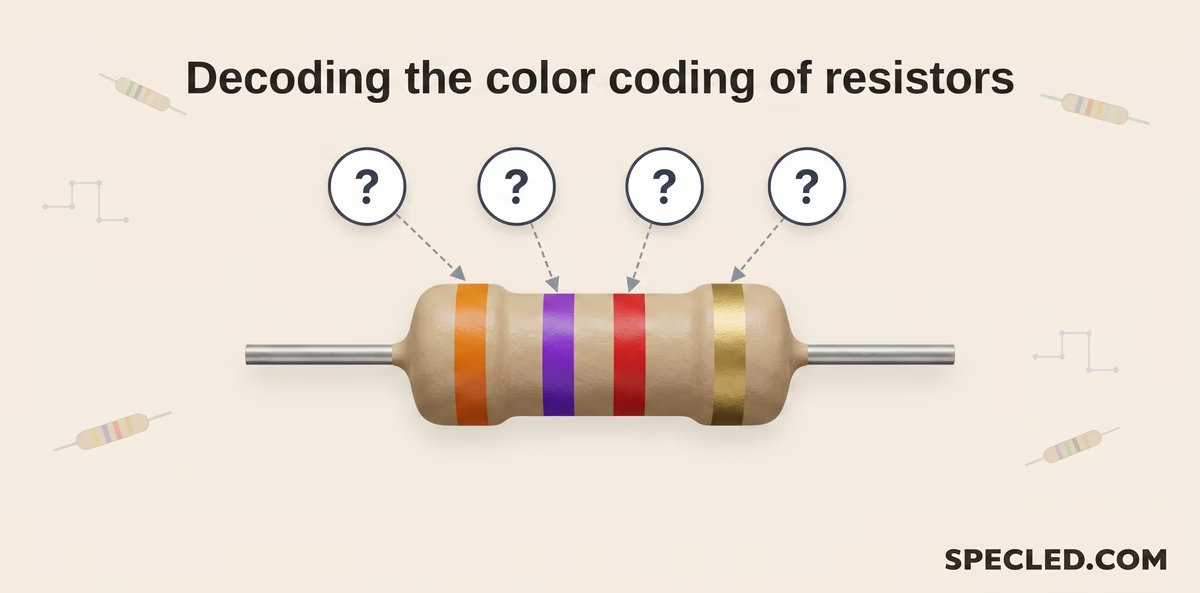
In modern electronics, color coding remains the only visual way to identify a component's value, not counting, of course, physical measurement with a multimeter. Need an accurate resistor color code calculator? The online tool on this page will help you solve this task in a couple of seconds, working flawlessly in both directions: from color to resistance and from resistance back to color bands.
To decode the numeric marking of modern SMD resistors, you can utilize the "SMD Resistor Numeric Marking↗" widget.Our calculator displays not only the resistance value but also the reference geometric dimensions and the tolerance class of the resistor.
How to use our calculator
Our widget is a powerful tool that operates in two modes:
- Find the value: Use our resistor color code calculator to determine the resistance of a part. Simply select the band colors in the widget according to their arrangement on the component's body, and you will get the exact value.
- Find the color bands: Enter the required resistance into the calculator, and the system will show you exactly what your component with colored rings should look like.
Our tool supports both the standard 4-band (E24 series) and the precision 5-band (E96 series) standards, making it indispensable when designing high-accuracy circuits. It simplifies the task and saves time! We highly recommend bookmarking it.
You can also use our calculator for calculating a voltage-dropping capacitor↗ to build a simple power supply or LED driver. This is especially useful in DIY projects.
How to read the chart of resistor color code
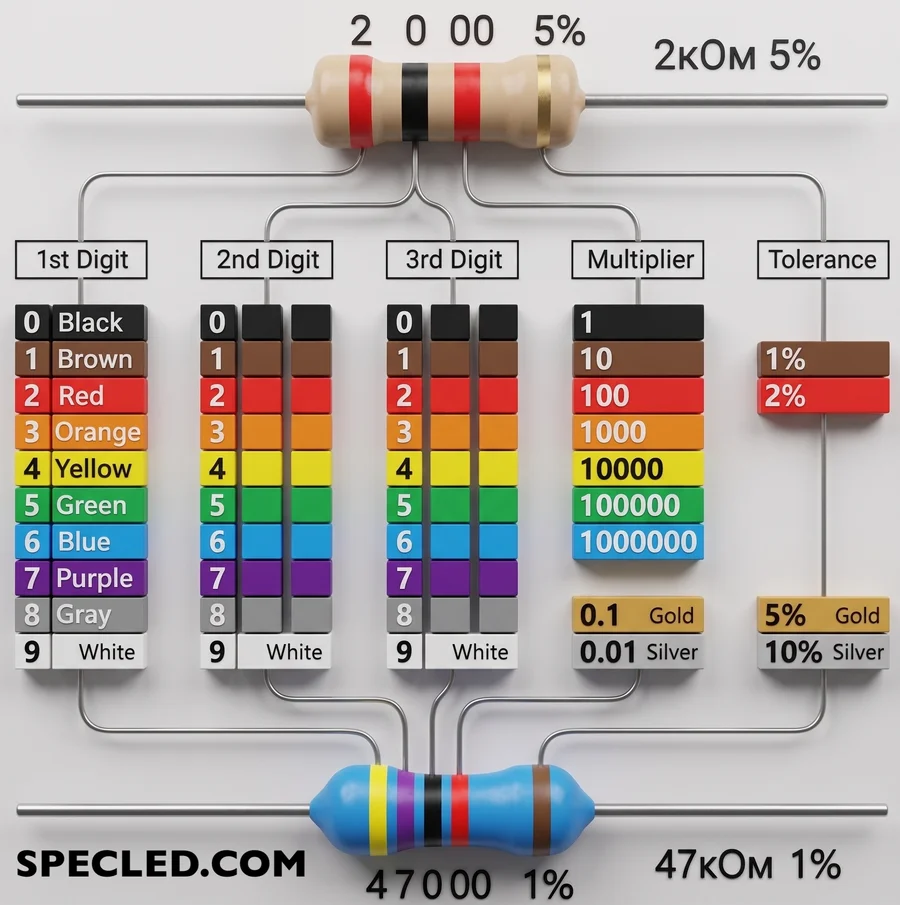
To make working with components easier, we have prepared the reference table that our algorithm relies on. If you want to know how to read resistor bands manually, use this guide:
| Color | Digit | Multiplier | Tolerance |
|---|---|---|---|
| Black | 0 | 1 | - |
| Brown | 1 | 10 | ±1% |
| Red | 2 | 100 | ±2% |
| Orange | 3 | 1,000 | - |
| Yellow | 4 | 10,000 | - |
| Green | 5 | 100,000 | ±0.5% |
| Gold | - | 0.1 | ±5% |
| Silver | - | 0.01 | ±10% |
Step-by-step reading guide:
- Find the starting point: Locate the band placed closest to the edge of the body. This represents the first significant digit.
- Second digit: The band following it is the second digit of the value.
- Third digit (for 5 bands only): If you have a precision 5-band resistor, the third band represents the third significant digit.
- Multiplier: The second-to-last band indicates the multiplier (what you multiply the base number by).
- Tolerance: The very last band (which often has a slight gap from the rest) shows the accuracy class or tolerance.
Here is an example of a classic resistor color chart:
Zero-ohm Resistors (Zero-ohm links)
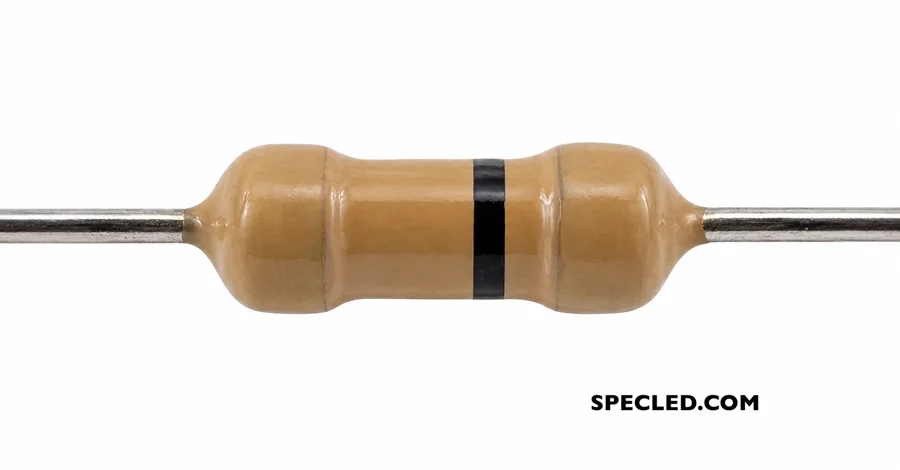
Sometimes on electronic circuit boards, you might come across a component whose resistor color code consists of just a single black band in the center. These are known as zero-ohm resistors or zero-ohm links. Essentially, they are just ordinary conductive wires packaged in a standard cylindrical body. Why is this necessary? It's all about robotic assembly: it is much easier for automated pick-and-place machines in factories to handle and solder a component in a standard package than to deal with a bare wire. Identifying this resistor value by color is extremely simple — a single black band always means 0 ohms.
How to read resistor color codes: which side to start from?
The most common problem beginners face is figuring out where to start reading. In a perfect world, the resistor color code chart dictates that the last band (the tolerance) should be positioned with a slight gap from the others. In practice, however, especially on cheaper components, the bands are often printed off-center or with completely equal spacing. How do you avoid making a mistake when trying to determine the resistor value by color? Remember a reliable rule of thumb: the gold and silver bands can never be the first digit. If you see gold or silver on one end, that is 100% the end of the code, and you must start reading the nominal value from the exact opposite side of the body.
Why is color coding better than printed text?
Historically, alphanumeric printing was widely used, but it had a major drawback: the text was often facing down towards the PCB or covered in flux/lacquer after soldering. Even worse, if a resistor burned out and blackened, it couldn't even be checked with a multimeter (due to an open circuit).
Modern color coding is a ring standard (EIA-RS-279). The paint is applied around the entire cylindrical body, meaning the value can be read from any angle of rotation on the board, and in almost any condition. This speeds up electronics assembly and repair significantly. While experienced technicians often memorize the colors, we created this convenient calculator for everyone else.
Now that we have covered resistor color coding, we can move on to the next common task: calculating the resistor for an LED↗. The need to calculate a resistor value frequently arises for DIY enthusiasts and those who are just starting to learn microcontroller programming with Arduino.
Don't forget to rate our widget using the rating system below, thank you!
SMD Resistor Marking
Although modern mass electronics has almost entirely transitioned to miniature surface-mount devices (SMD), where numbers are printed instead of color bands (for example, the marking "103" stands for 10,000 ohms), classic through-hole resistors are not going anywhere. They remain the standard in DIY projects, breadboard prototyping (e.g., for Arduino), high-end audio equipment, and, of course, when repairing older gear. Therefore, the ability to quickly decode 4-band and 5-band resistor color codes is a fundamental skill that distinguishes a good technician.
Need to calculate the total resistance and power of resistors? Series and parallel resistor connection calculator↗.