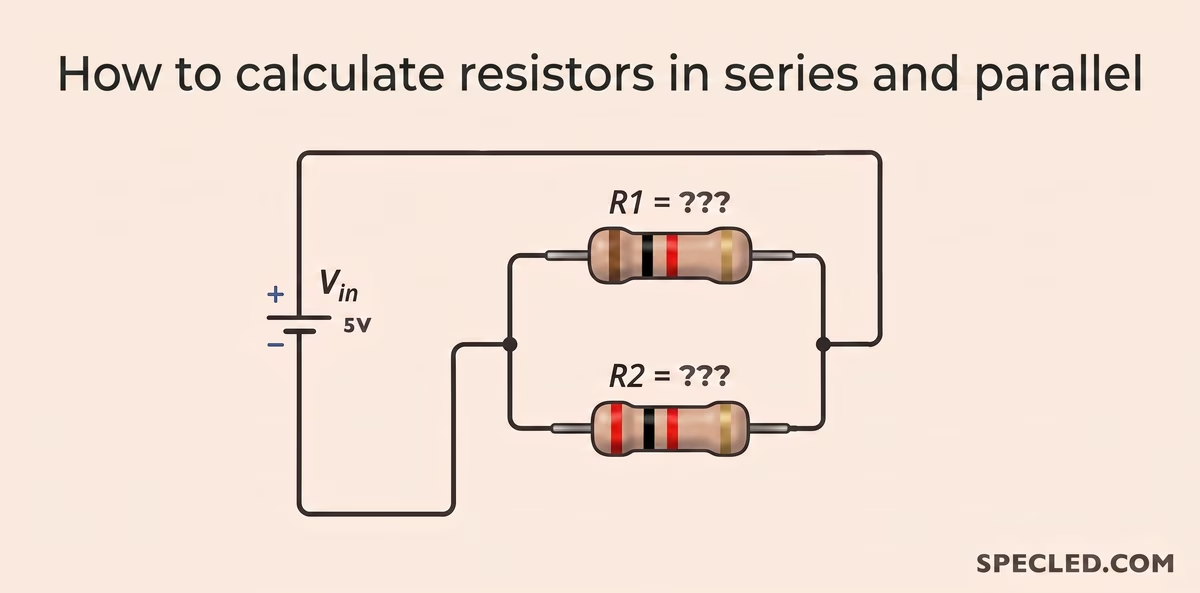
Missing the resistor of the required rating on hand? Need a higher power resistor? For example, for current limiting, a resistance of 15 Ohms is urgently required, but the parts bin only contains 10 Ohm and 30 Ohm components. What to do in such a situation? Wait for delivery? Oh no, you can solve the problem quickly and qualitatively using the resistors you have on hand.
You can use a separate calculator that allows you to calculate the resistor for an LED↗.
In such cases, a basic law of circuit design comes to the rescue — series and parallel connection of resistors. By competently combining components, you can obtain absolutely any non-standard resistance value, as well as increase the allowable power dissipation of the assembly. In this article, we will analyze the physics of these processes in detail, provide classic formulas, and show how to avoid errors when designing circuits.
Standard resistors possess marking made with color rings. We have created a convenient reference widget that explains what is: color coding of modern resistors↗.
Series Connection of Resistors: Simple Addition
Series switching is the simplest type of connection, in which elements line up one after another in a single circuit, like train cars. The end of the first resistor connects to the beginning of the second, the end of the second to the beginning of the third, and so on. The electric current flowing through such a circuit has only one path, so its value on each element is absolutely identical.
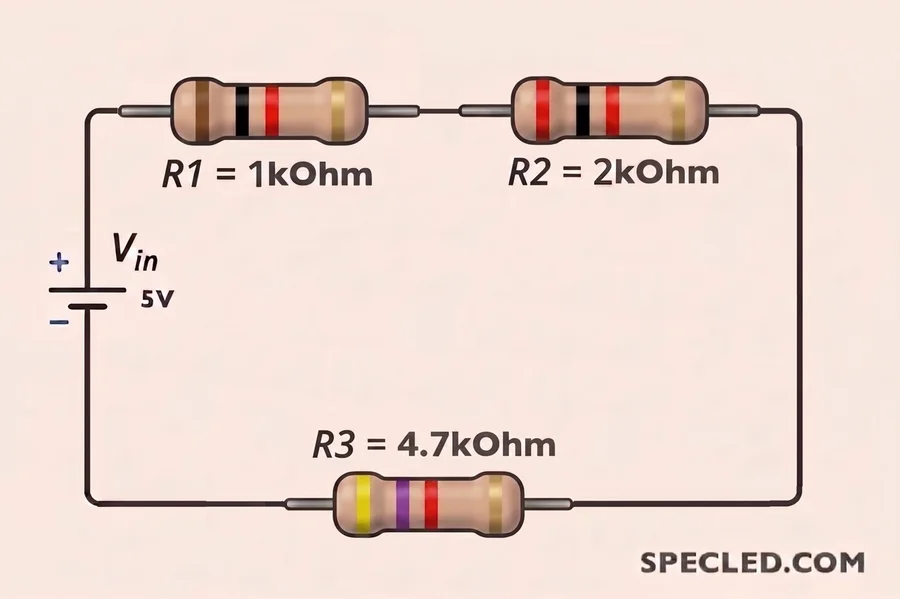
The physical sense of such a connection lies in increasing the total obstacle in the path of the current. Consider this as narrowing the pipe through which water flows: the narrower the pipe, the more difficult it is for water to force its way through it. The formula for calculation is extremely simple: the total resistance is equal to the algebraic sum of all elements in the chain:
R_total = R1 + R2 + R3 + ... + Rn
If you connect 10 kOhm and 4.7 kOhm resistors in series, the total resistance will be exactly 14.7 kOhm.
Series connection of resistors — the easiest way to increase the total resistance of a circuit. In a series connection, the same current flows through all resistors, and the total resistance and power dissipation are equal to the sum of the corresponding values of all resistors.
How Does Parallel Connection of Resistors Work?
Unlike a series chain, parallel connection of resistors implies that all beginnings of the components connect into one common circuit node, and all ends into another. The current, reaching the first node, divides and flows through several parallel branches simultaneously, and then merges together again.
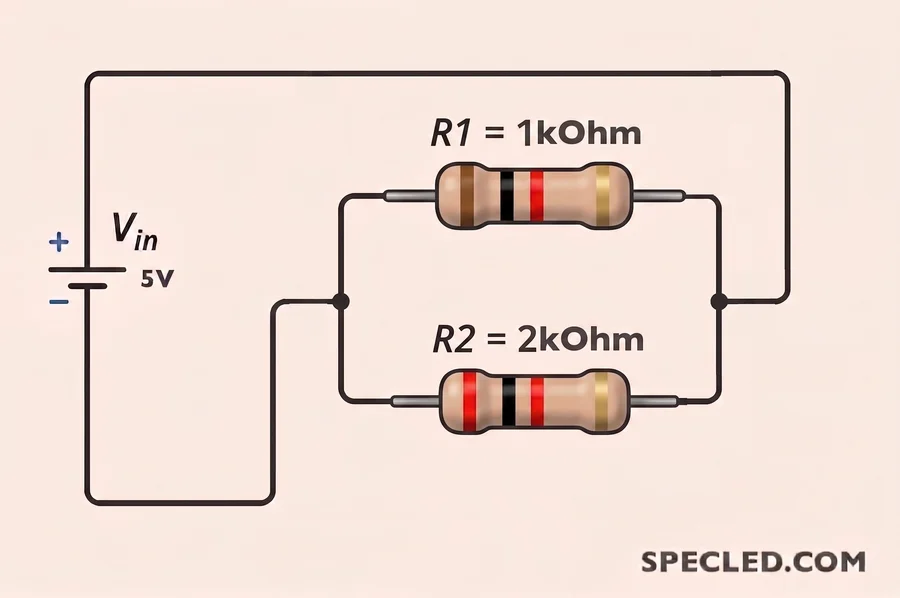
From the point of view of physics, by applying parallel connection of resistors, you do not make the "pipe" thinner, but on the contrary, increase its total cross-section. It becomes easier for the current to pass through the circuit section, as it has additional paths. That is why with this type of switching, the total resistance of the assembly always decreases.
An important rule: the resistance of parallel resistors in the end will always be less than the rating of the smallest resistor involved in the assembly. If you connect a 1 MOhm (one million Ohms) part and a 10 Ohm part in parallel, the resulting resistance will be slightly less than 10 Ohms.
Precise Formula for Parallel Connection of Resistors
Mathematically, calculating parallel connection of resistors looks like adding reciprocal values (conductances). The general formula for any number of parallel branches looks as follows:
1 / R_total = 1 / R1 + 1 / R2 + 1 / R3 + ... + 1 / Rn
If only two components are used in the circuit, engineers apply a simplified derivative formula that allows faster calculation on a calculator and avoids getting confused in fractions. This parallel resistor connection formula looks like this:
R_total = (R1 * R2) / (R1 + R2)
Let's check it in practice. If we take two resistors of 100 Ohms each, then: (100 * 100) / (100 + 100) = 10000 / 200 = 50 Ohms.
A handy life hack: if you connect two identical resistors in parallel, their total resistance is exactly half their rating!
Parallel and Series Connection of Resistors: Power
Why do electronics designers often intentionally use cumbersome parallel and series connection of resistors, even when the catalog has a part of the required rating? The answer lies in power dissipation.
Any resistor passes current generates heat. If the power limit is exceeded (for example, applying 1 W to an 0805 format SMD resistor rated for 0.125 W), it will overheat and burn out. When you use parallel connection, resistance not only drops but also distributes the current load between components.
An information widget with resistance decoding and dimensions of various SMD resistors is in the article — "digital marking of SMD resistors↗".
If you connect four 100 Ohm resistors with a power of 0.25 W each in parallel, you get a total resistance of 25 Ohms, but this assembly will be able to safely dissipate already 1 W of heat (0.25 W * 4). This is a critically important technique when repairing power supplies or assembling LED drivers.
Calculating Parallel Connection of Resistors: Table of Popular Ratings
To speed up your work with typical components (for example, from the popular E12 series), I made a table showing the result of combining two frequently encountered ratings.
| Resistor 1 (R1) | Resistor 2 (R2) | Total Resistance (R_total) | Application |
|---|---|---|---|
| 10 kOhm | 10 kOhm | 5.0 kOhm | Standard logic, microcontroller pin pull-up. |
| 4.7 kOhm | 4.7 kOhm | 2.35 kOhm | I2C buses (SDA/SCL), analog filters. |
| 1.0 kOhm | 10 kOhm | 909 Ohm | Precise voltage reference tuning. |
| 100 Ohm | 47 Ohm | 31.97 Ohm | Current limiting on powerful LED matrices. |
| 330 Ohm | 220 Ohm | 132 Ohm | Current loop, interface protection. |
Convenient Parallel Connection of Resistors Calculator
As can be seen from the table, calculating two identical parts causes no problems. But what to do if you need to combine three or four components of completely different ratings (for example, 15 kOhm, 10 kOhm, and 22 kOhm)? Manual calculation through fractions takes time.
It is specifically to solve this task and for learning that we have developed our interactive calculator for parallel and series connection of resistors. This professional widget possesses the following advantages:
- Instant result: Enter values and immediately get the total resistance without reloading the page.
- Automatic conversion: Our parallel resistor connection calculator will itself bring Ohms, kOhms, and MOhms to a common denominator.
- Absolute precision: The system uses not rounded values, but exact mathematical models for calculating complex mixed circuits.
Add this page to your browser bookmarks. When you next find yourself at the desk with a soldering iron and a bunch of miscellaneous resistors, our tool will help you find the ideal combination for repairing your board in a couple of seconds!