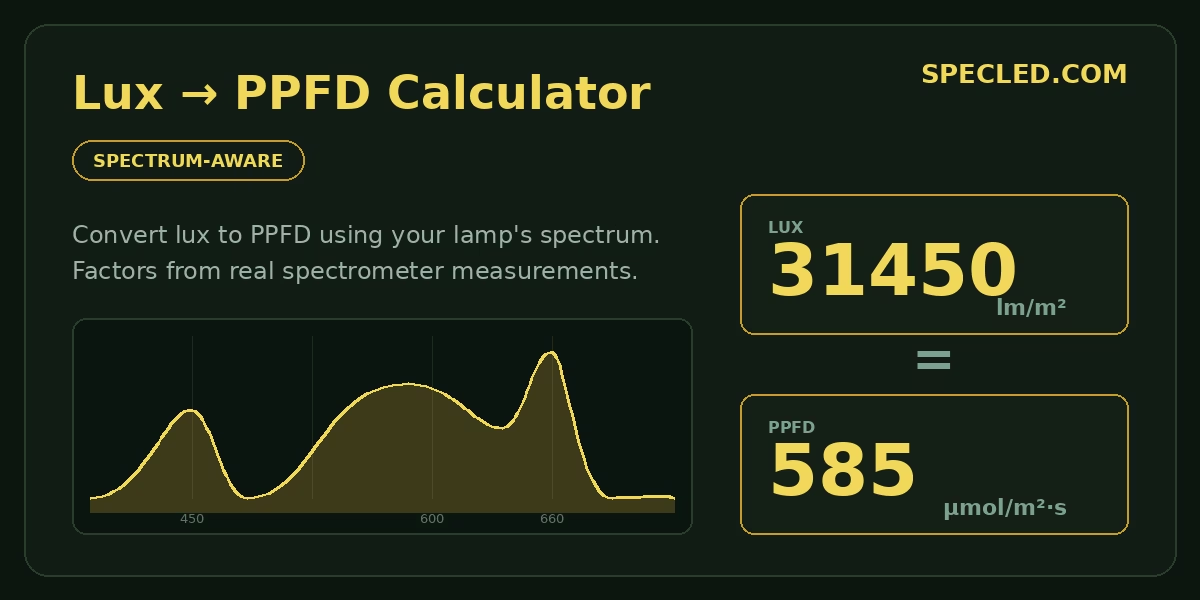
A professional quantum meter (PAR meter) costs anywhere from a few hundred to a thousand euros. A standard lux meter costs just a few euros, and it's often already built into your smartphone. It’s logical that growers want to measure their light using a cheap lux meter. There’s just one problem: plants care about PPFD (Photosynthetic Photon Flux Density), while a lux meter measures lux. Our calculator above converts one to the other — but unlike most formulas on the internet, it does so by accounting for the specific spectrum of the lamp! You can even adjust the spectrum manually across 6 channels! Or select the HPS spectrum, which isn't 100% perfectly drawn but provides a 99% accurate calculation. Below, we’ll explain why this is fundamentally important and why the "universal" conversion factor is a lie.
Why You Can't Just Multiply Lux by a Single Factor
The web is full of "universal" formulas like "divide lux by 67" or "multiply by 0.015". They produce massive errors, and here’s why.
Lux is not the physical power of light. It is illuminance, weighted according to the sensitivity of the human eye. The human eye is highly uneven: it’s most sensitive to green-yellow light (around 555 nm) and almost completely blind to deep red (660 nm) and blue (440 nm). Yet, it’s exactly these red and blue photons that are critical for photosynthesis. You can also learn more about lumens, lux (lux is the number of lumens per square meter), the human eye sensitivity scale, and a comparison of lumens with PPFD using a visual widget↗ by following the link.
What this means is that a lux meter systematically "undercounts" the very red and blue photons that a plant needs. A 660 nm red LED delivers a massive photon flux for a plant, but a lux meter barely registers it. Therefore, the exact same PPFD value from lamps with different spectrums will yield entirely different lux readings — and vice versa.
This is exactly why a conversion factor cannot be universal. It depends entirely on the lamp's spectrum. My calculator determines this coefficient based on the spectrum — for SPECLED modules, it uses real data measured with an Ocean Optics STS-VIS spectrometer↗ (all tests can be found on our YouTube channel,↗ which is where the numbers for calculating the coefficients came from), and for other lamps, it estimates it based on the pre-configured spectrum.
Every Lamp Type Has Its Own Coefficient
To prove this isn’t just empty talk, here are real coefficients measured by our spectrometer. The coefficient shows how many µmol/m²·s (PPFD) you get per 1000 lux:
| Lamp / Type | Spectrum | Coefficient (PPFD per 1000 lux) |
|---|---|---|
| HPS 600W | Yellow-orange, narrow | 11.6 |
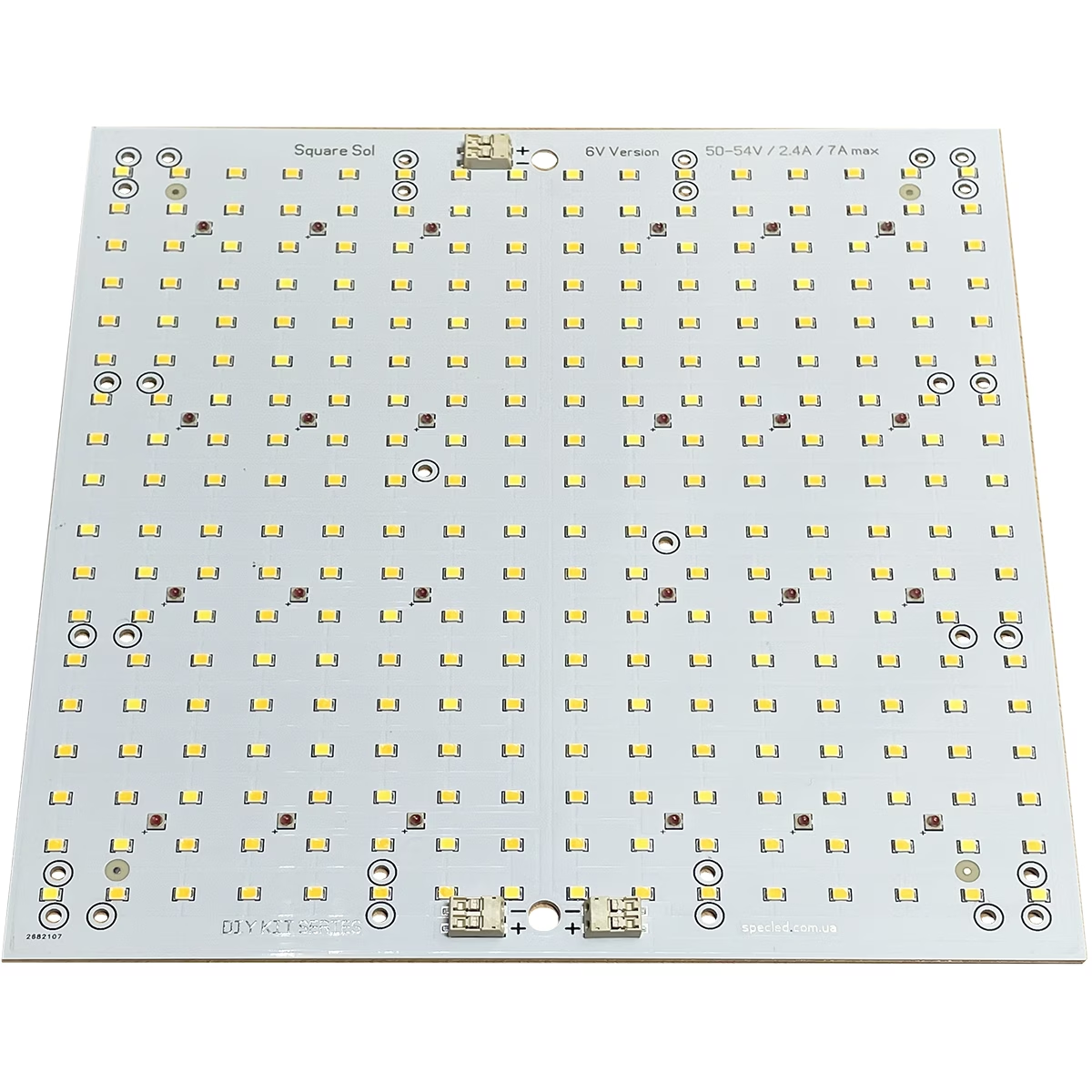
| Square Sol 6V | Full spectrum, CRI 93 | 16.5 |
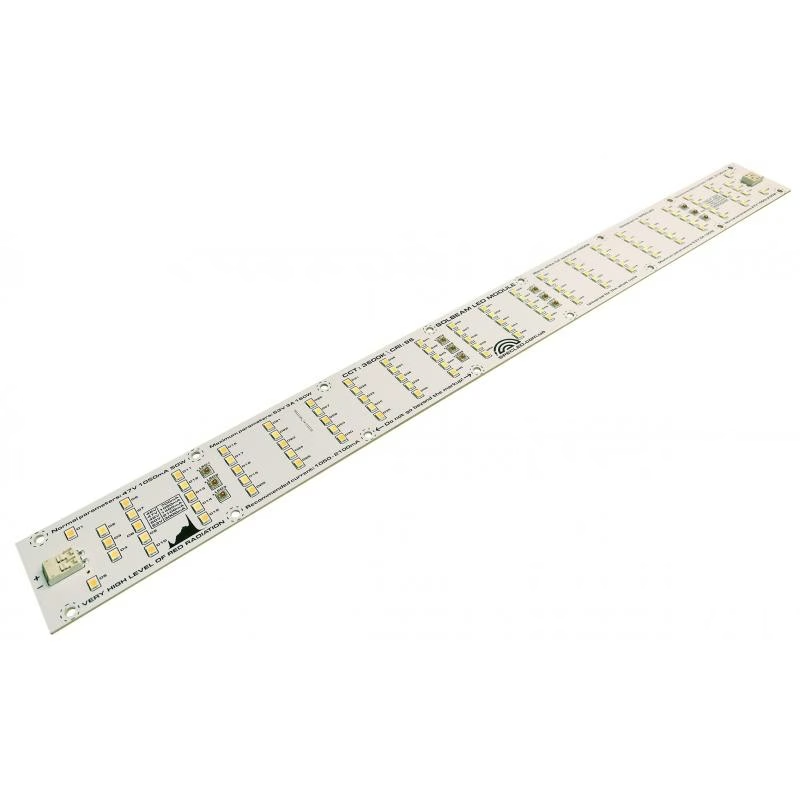
| Sol Beam V3 | Full spectrum + 660 nm, CRI 96 | 18.6 |
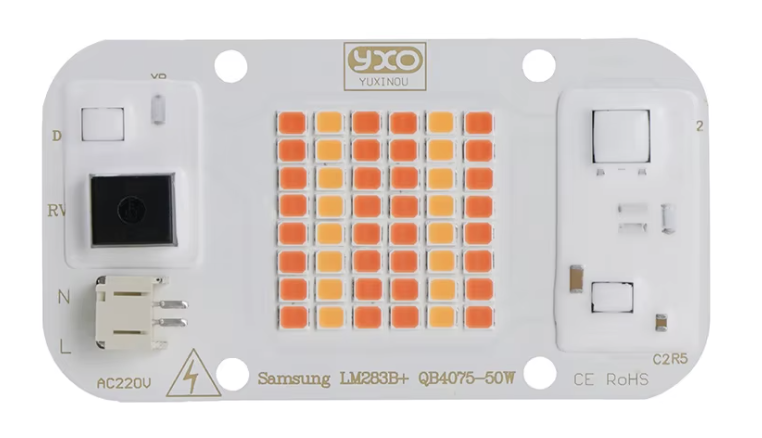
| Full spectrum COB, 50W - 220V "iron" from Ali | Warm, shifted to red | 24.1 |
| Bi-color (blue-red) | 440 + 660 nm | 98.6 |
The range goes from 11.6 to 98.6. That’s an 8.5-fold difference. If you took a "universal" coefficient and applied it to a blue-red lamp, you’d be off by nearly an order of magnitude. The logic is simple: the more a lamp's spectrum is shifted into the zone invisible to the human eye (deep red, blue), the higher the coefficient. An HPS lamp shines in the yellow-orange zone, which the eye sees perfectly — so it has the lowest coefficient. A bi-color lamp shines where the eye is almost blind — making its coefficient the highest.
The calculator also clearly demonstrates how much worse a matrix is compared to normal modules. The numbers are given for 50W, and that’s without even considering that 220V full-spectrum matrices degrade quite fast. The matrix in the photo below is one of the better options among these "irons":
Can I Convert lumens to PPFD from an HPS Lamp?
Yes, there is a dedicated preset for HPS in the calculator — I measured the spectrum of an Osram 600W sodium lamp with the spectrometer and hardcoded its real coefficient. Just select the "HPS" preset and input your lux meter readings.
Example of an HPS lamp spectrum:
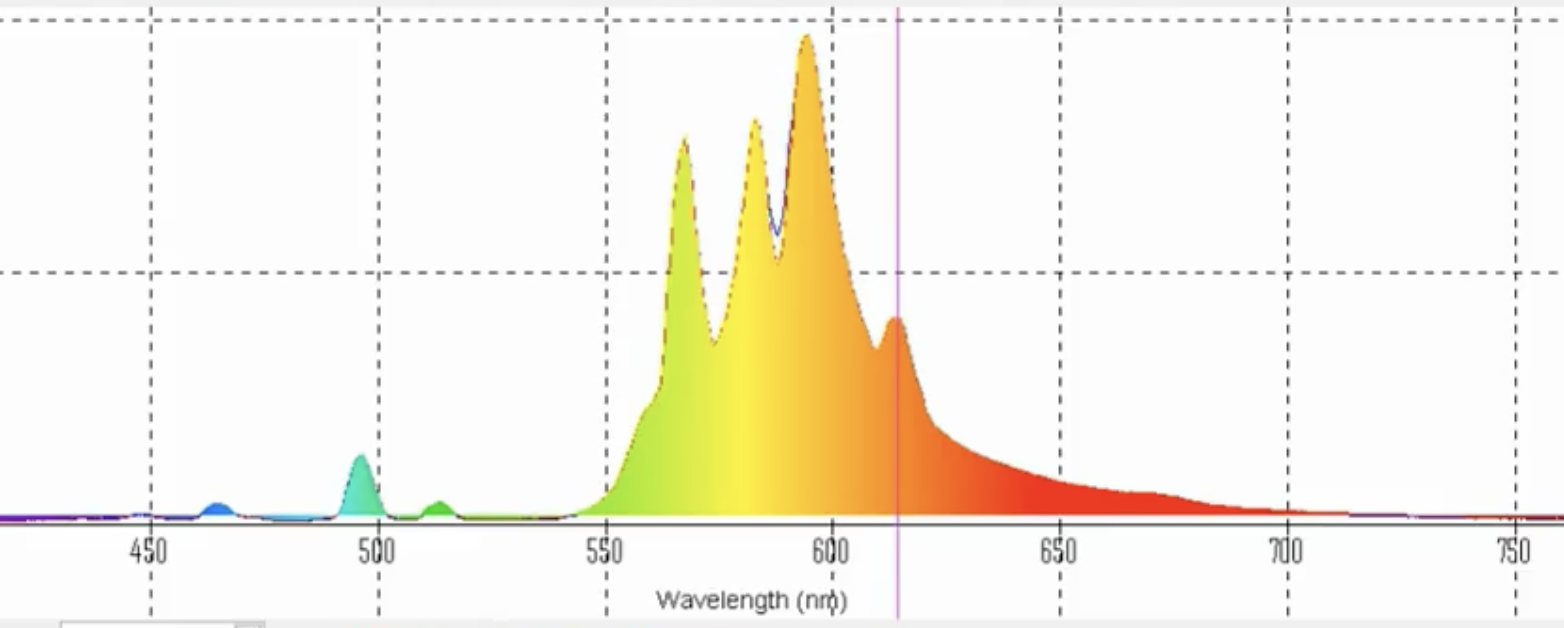
One caveat: the spectrum of different HPS lamps varies slightly depending on the manufacturer, wattage, and wear. I once measured three different sodium lamps (Osram, Lucalox, Bellight) — their coefficients came out very close (10.9–11.6), so the preset yields a good result for most HPS bulbs. But if your specific lamp's spectrum differs noticeably (for instance, an old, "burned-out" bulb shifting its spectrum), there might be a slight margin of error. However, for critical tasks, the calculation is still accurate enough.
How to Use the converter LUX to PPFD (PAR)
The process is simple:
- Set the lamp's spectrum. Choose a ready-made preset for your model (the coefficient for lamps based on SPECLED modules has already been measured by a spectrometer) or adjust the spectrum manually using the sliders if you have a different type of lamp. This is a fundamental, unique feature of my Lux to PPFD converter!
- Enter the illuminance. Take a reading with your lux meter right at the canopy level or wherever you need it, and input the value — either using the slider or by typing the number manually (the field allows for it).
- Check the result. The calculator will display the PPFD in µmol/m²·s. If needed, switch the PAR range (400–700 nm) to ePAR (400–780 nm) to account for far-red light.
Important: measure with the lux meter at the exact point where the plant is growing, and hold the sensor horizontally. PPFD, just like lux, is a point-specific value, so the readings directly under the center of the lamp and at the edges of the tent will be different.
A ready-made example convert lumens to PPFD for three different light sources:
| Lux to µmol/m²·s | SolBeam V3 Led Module | HPS | Bi-Color LED |
|---|---|---|---|
| 50000 Lux | 930 µmol/m²·s | 580 µmol/m²·s | 4930 µmol/m²·s |
| 20000 Lux | 372 µmol/m²·s | 232 µmol/m²·s | 1972 µmol/m²·s |
| 10000 Lux | 186 µmol/m²·s | 116 µmol/m²·s | 986 µmol/m²·s |
| 5000 Lux | 93 µmol/m²·s | 58 µmol/m²·s | 493 µmol/m²·s |
Why shouldn't you choose a grow light based on lux? A recap.
The table above leads to an unexpected, yet crucial conclusion: you cannot compare or choose a lamp based on lux. A lux meter will deceive you twice. Really?! Maybe even three times.
Imagine comparing a cheap Chinese COB matrix to a professional module based on lux readings. The matrix has a coefficient of 24.1 versus 16–18 for quality modules — meaning at the same lux level, it will show a higher PPFD. It makes the matrix look "more powerful". But that’s an illusion: its high coefficient simply means its warm light is shifted into a zone the eye struggles to see. At the same power consumption, it delivers almost half as many photons to the plant as a professional module, and it does so with an inferior spectrum and a low color rendering index. I haven't written anything groundbreaking here, but many people still fail to properly compare good vs. bad, and it honestly still surprises me. The numbers don't lie, they scream the truth, but nope, it's not always possible to prove the facts.
Another example is HPS. It has the lowest coefficient (11.6) because the eye sees yellow light perfectly. On a lux meter, HPS will look "brighter" than many LEDs, but again, that doesn't mean the plant is getting more useful light. I’d say — quality light, since all light in the ePAR range is useful. But not every full spectrum is truly full and balanced.
Conclusion: a lux meter is a handy tool to measure a single known lamp and convert its readings into PPFD using the correct coefficient. But it is completely useless and misleading when comparing different lamps against each other. To choose a lamp, look at the measured PPFD at a known wattage and the quality of the spectrum, not the lux output. We've developed an interactive educational widget that clearly demonstrates the difference between PPF and PPFD↗—I highly recommend checking it out.
This calculator is designed to help growers who want to know the PPFD illuminance in their tents with high precision. Sorry, I didn't include a conversion for CFL lamps, because I consider CFLs as extinct as dinosaurs today. For context, here is their spectrum:
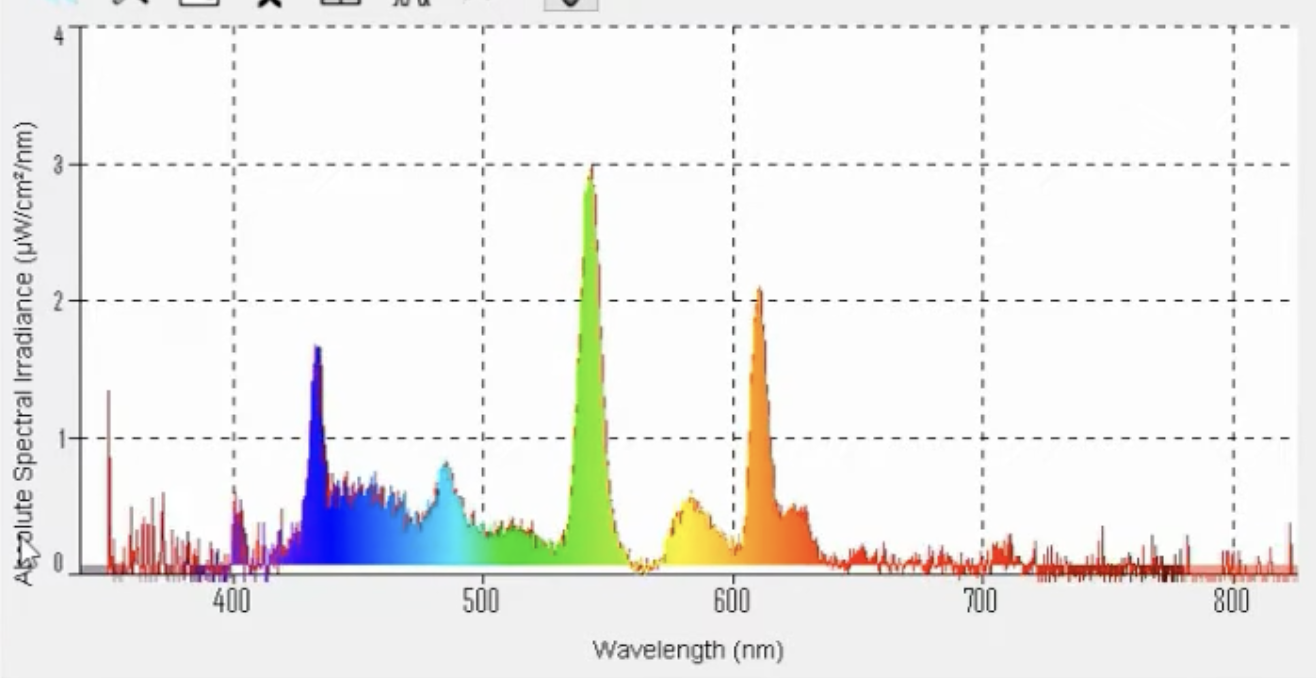
It's a spiky, mountainous spectrum of a CFL bulb. Not bad in blue and green, terrible in red. Do they even sell CFL bulbs anymore? :)