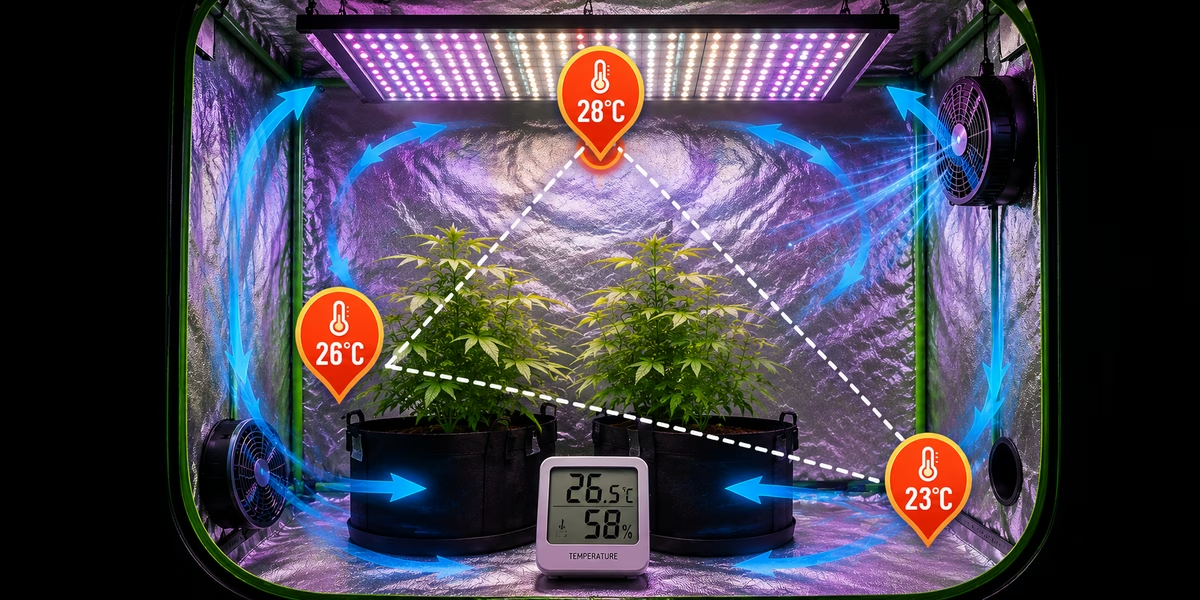
Most growers hang a single thermometer somewhere in the middle of the tent, see their comfortable 26 °C, and go to sleep. Meanwhile the plants are living in three different climates at once. A grow tent isn't one temperature — it's a vertical layer cake, and measuring it at a single point almost guarantees you're fooling yourself. Let's break down why you need at least three sensors, and why even a perfect exhaust fan won't save you without circulation fans.
Air in the tent stratifies — that's physics, harsh and unforgiving
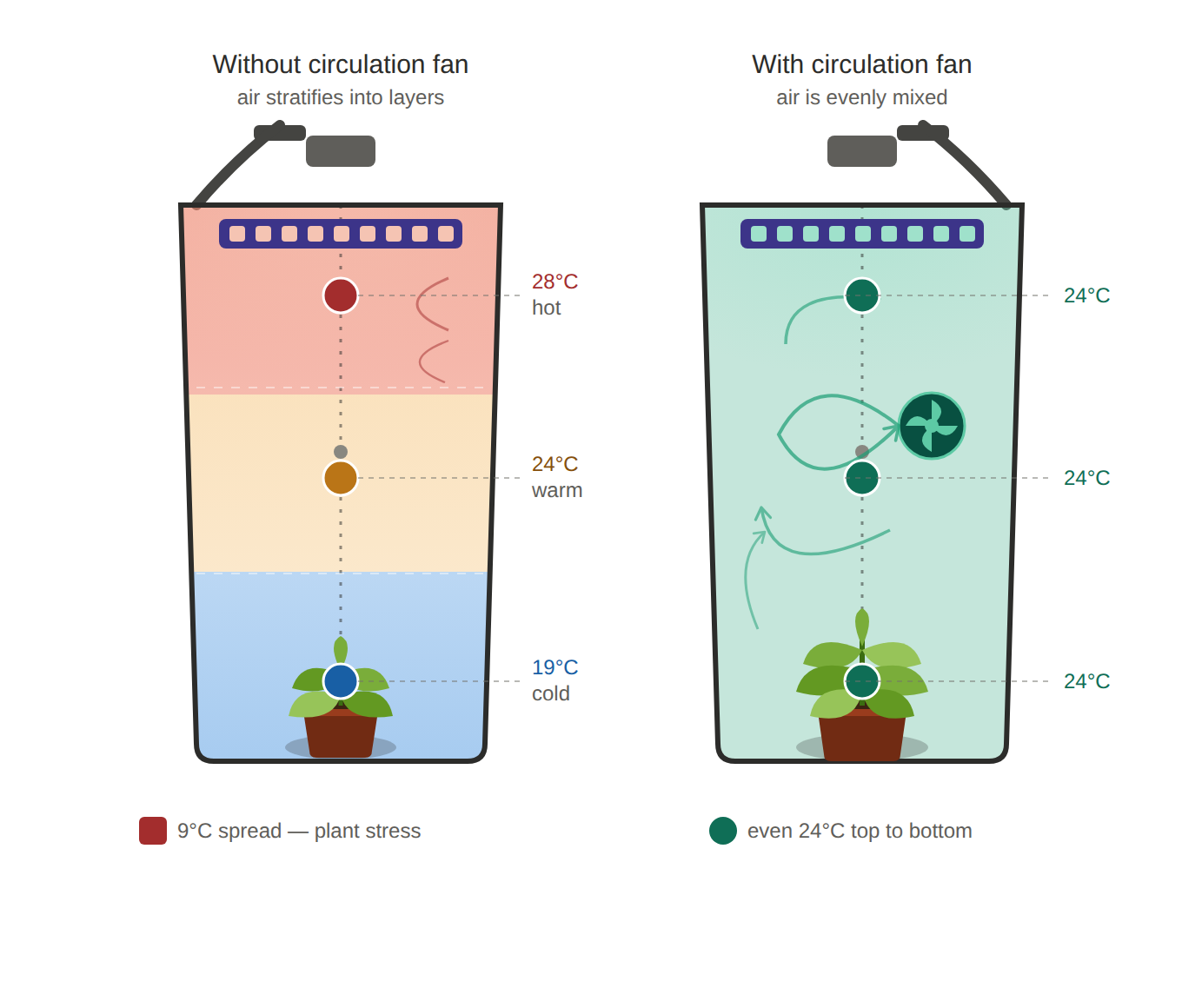
Warm air is lighter than cold air and always rises. In a closed box with a light at the top, this creates stable stratification: it bakes under the fixture, it's cool at the floor, and the difference between top and bottom easily reaches 3–6 °C — more in tight tents with powerful lights. A single sensor shows the temperature exactly where it hangs and tells you nothing about what's happening 40 cm above or below. And for a plant, those 40 cm are a whole lifetime: the canopy sits under the lamp while the roots sit in pots on the floor. Imagine one plant with its roots in Norway and its crown in South Africa. Or your head in Egypt and your feet at the North Pole — and you have no idea.
And this stratification isn't only vertical. Horizontally there are zones too: it's fresh near the intake, warmer and drier near the exhaust, and the air barely moves in the corners. So even at the same height, two corners of the tent can differ by a couple of degrees, and the "average temperature" becomes a fiction hiding a dozen different microclimates.
Three temperature measurement points
Top, at the canopy under the light. The hottest zone. Here you catch canopy overheating and learn whether the light hangs too close. An overheated top closes its stomata and slows photosynthesis, even when the "tent average" looks perfect.
Canopy level (leaf). This is your main working temperature — it's what VPD is calculated from and how the plant actually breathes. The sensor here should hang at leaf height, in the shade, not dangle somewhere by the wall. For VPD calculation↗, use our online calculator.
Bottom, the root zone. Roots like 18–22 °C and dislike surprises. The floor is often colder than it seems, while a heat mat can easily overheat the pot. Cold roots draw water and nutrients poorly — and the tops suffer, even though the problem is at the bottom.
Three numbers together give you not just a "temperature" but a gradient. If top and bottom differ by a couple of degrees — great, the air is mixed. If it's five to seven — you have stagnation, and that's a diagnosis, not a trifle. Fix it urgently!
Where you must not place the sensor
A separate rake to step on: never put the sensor under the lamp's direct beam. Never, however tempting. Like a leaf, it heats up from radiation and will read several degrees above the real air temperature. The sensor must be shaded, sit in the airflow, and hang at canopy level. Keep in mind: air temperature and leaf temperature are not the same thing. A leaf that's actively transpiring can be 1–3 °C cooler than the air — and under a powerful LED in still air, the opposite, hotter. Three air points don't replace that, but they at least give an honest picture of the environment. In effect, three points are the "ward average": if one patient is sick and one is healthy, on average both are sick. And that really is how it works.
Why an exhaust fan isn't air mixing
This is where many beginners' intuition breaks. "I have a powerful exhaust, the air changes over" — yes, but the exhaust pulls air along the shortest path from intake to outlet and leaves dead zones where it stagnates. It removes excess heat and humidity from the tent as a whole, but pockets still build up inside: hot under the lamp, humid deep in the foliage, stagnant in the corners. Mixing is a separate job, handled by circulation fans — those clip-on fans and desk fans that move air inside the tent rather than throwing it outside. Mixing the air inside the tent really is a genuinely important thing.
What circulation fans actually do
The main thing a light, constant breeze does is strip the boundary layer off the leaf. Around every leaf sits a thin film of still air: saturated with moisture and depleted of carbon dioxide. In still air this film is thick — the stomata "breathe" through a humid cushion, transpiration slows, and fresh CO₂ simply doesn't reach the stomata. Airflow thins the film, gas exchange speeds up, and the plant both transpires more efficiently and photosynthesizes more actively.
Next, climate evening-out. Moving air erases the difference between top and bottom, between center and corners. Those three sensors start reading close numbers, VPD becomes uniform across the canopy, and the bush grows evenly rather than on a "whoever's closest to the window" basis.
Disease prevention. Stagnant humid pockets deep in the bush are a perfect home for mold, gray rot, and powdery mildew. Constant air movement keeps moisture from settling on the leaves and sharply lowers the risk.
Sturdy stems. Plants sense wind — it's called thigmomorphogenesis — and respond by thickening their stems. A wind-exposed bush stands firmer and holds a swelling harvest better than one pampered in dead calm. Metabolism improves too.
And finally, CO₂. Carbon dioxide is heavier than air and, at rest, tends to settle down low, past the leaves. Mixing lifts it up to the canopy where it's needed — especially if you supplement CO₂ and don't want it uselessly pooling at the bottom. Incidentally, CO₂ supply is best arranged from above for maximum efficiency.
We take a closer look at the FvCB photosynthetic gas-exchange model↗ and examine how air temperature, CO₂ concentration, and humidity interact with one another and affect photosynthesis. The article also includes our photosynthesis simulator.
By the way, a "cooler" is a cooling system, not a fan, strictly speaking. A heatsink and a fan together make a cooler, but you don't hang a full CPU cooler in a grow tent to mix air. So the correct word is "fan." Thanks for your attention.
Airflow strength — it's windy today
You set airflow strength by eye, without fanaticism: the leaves should gently stir and flutter, but not thrash as in a storm — a hurricane in the tent dries and batters plants no less than stagnation does. Place one fan to push air over the canopy and, if possible, a second under the canopy to break up the cool layer near the pots. Don't aim the flow point-blank at the plants: send the air slightly above them or along the wall so it swirls and mixes through the whole volume. And keep the airflow on around the clock — stagnation returns within minutes after the fan switches off.
Airflow and temperature measurement are one question
The beauty is that the two questions are really one. Three sensors show you the problem: stratification, an overheated top, cold roots. And circulation fans are the tool that cures it. Measure a 6 °C gradient between floor and lamp, add airflow, get the air moving, measure again — and see 1–2 °C. Without measuring, you don't know what to fix. Without mixing, you have nothing to fix it with — short of waving a fan by hand, but the efficiency is low. So airflow and air mixing are absolutely not something to ignore.
The short version
One number on one thermometer is an illusion of control. To check, place a sensor at three heights: under the lamp, at canopy level, and at the roots; shade them and keep them in the airflow. Without mixing, the temperature will differ. Then give the tent constant gentle airflow from circulation fans — not instead of the exhaust, but together with it. An even climate with no hot or stagnant zones isn't pedantry — it's a direct boost to plant health and yield: every leaf works in its own optimal conditions rather than in a "ward average." Do it all right, and there's even no point measuring temperature at three points — the key is not to ignore air mixing in the grow tent.