Not so long ago, far-red light (700–750 nm) was considered useless in horticulture. It sits outside PAR — the 400–700 nm range conventionally treated as photosynthetically active — and lamp manufacturers either left it out entirely or added it as a token gesture, much as UV and IR are added to cheap boards today. Now 730 nm LEDs appear in almost every grow light, and specifications increasingly quote ePAR: the photon output counted with far-red included. How much of it you actually need is what this article is about.
Five terms you need first
Phytochrome
A photoreceptor protein the plant uses to measure light — not for photosynthesis, but for decision-making. Phytochrome answers questions like "is it light", "is the day long", "has a neighbour shaded me", and from those answers the plant decides whether to stretch, branch or flower. A sensor of circumstances, separate from the energy machinery of the chloroplasts.
Pr and Pfr — the two forms of phytochrome
Phytochrome exists in two states that light switches between. The Pr form absorbs red around 660 nm and converts to Pfr. The Pfr form absorbs far-red around 730 nm and converts back to Pr. Pfr is the active one — it triggers the biochemical cascades. So it works as a switch: red light turns it on, far-red turns it off.
PSS — phytochrome photoequilibrium
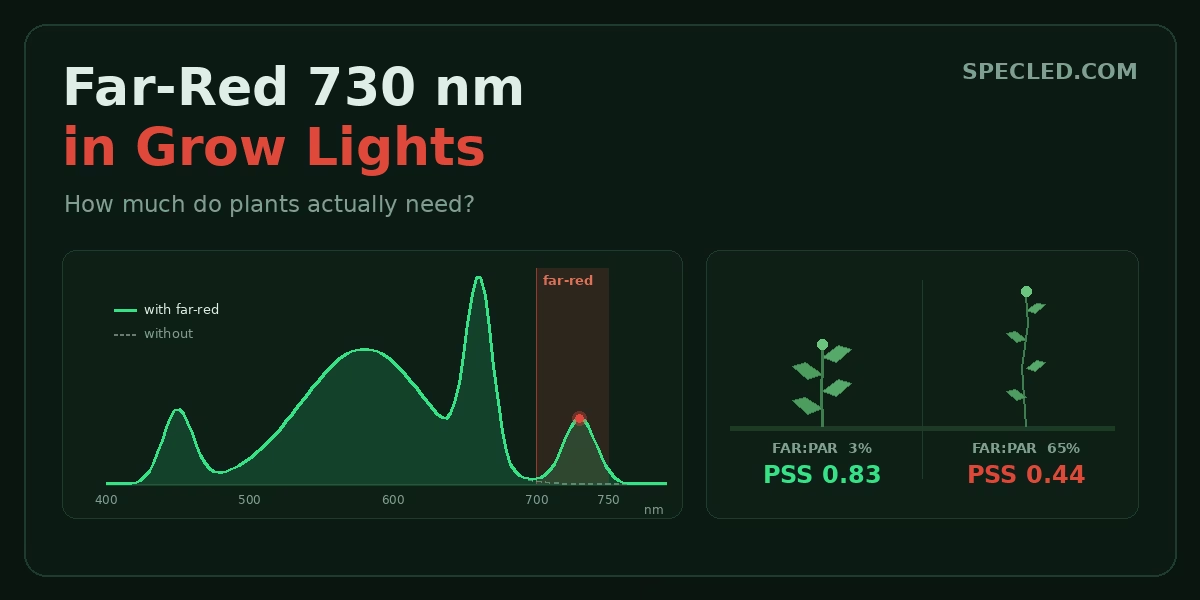
Under steady illumination a balance between the two forms is established. PSS (phytochrome photostationary state) is the share of the active form out of total phytochrome, a value from 0 to 1. Under open sunlight it is around 0.7, under a pure red LED about 0.9, under a canopy it drops to 0.4 and below, and in deep shade down to 0.2.
PSS gives an approximate reading of the signal the plant receives. The word "approximate" matters here: the calculation relies on phytochrome photoconversion coefficients, and different research groups publish noticeably different sets, so the same lighting can be reported with PSS values differing by several hundredths.
R:FR — the red to far-red ratio
The oldest and simplest metric: how many photons fall in the red band against the far-red band. Under open sky it is about 1.1. Under a leaf canopy it drops several-fold, because leaves absorb red and let far-red pass through. It is precisely this imbalance that tells the plant it is shaded.
FAR:PAR — the far-red fraction
The youngest of the metrics: what share the 700–760 nm photons make up relative to the main 400–700 nm light. For sunlight this is around 15–17%, for an ordinary grow light without dedicated LEDs 0–4%, and in deep shade it reaches 50–70%. Work by Kusuma and Bugbee has shown that this particular value predicts stem length and leaf area better than PSS or R:FR — and does so consistently across sources with different spectra.
To determine the red component in the spectrum of an LED or lamp, you can use the spectrum digitization tool↗. This tool allows you to perform a basic spectral analysis and compare the results with the McCree curve and the solar spectrum.
Why far-red was considered useless
The PAR boundary at 700 nm did not appear by accident. The classic quantum yield measurements by McCree in the seventies showed a sharp drop in efficiency beyond the red peak. A 730 nm photon carries less energy than photosystem II needs to drive its reaction, and on its own it does very little.
Hence the practical conclusion that held for decades: light beyond 700 nm is heat, not food. Lamps were rated by PPF in the 400–700 range, far-red was left out of the accounting, and everything added up.
The problem was in the phrase "on its own". McCree's measurements used monochromatic light — one wavelength at a time. That is the correct way to build a quantum yield curve, but it answers the question "what does a photon of this wavelength do by itself", not "what does it do as part of a real spectrum". And in nature a plant is never lit by a single wavelength.
Curiously, the answer to that question was obtained before the PAR boundary itself came into common use. Emerson's work dates to the fifties, McCree's curve to the seventies. One line of research was concerned with the mechanism of photosynthesis, the other with measurement practice, and they only truly converged once LEDs made it possible to assemble a spectrum piece by piece and test the effect directly.
The Emerson effect: why far-red works in company
Back in the fifties Robert Emerson noticed something odd. He illuminated Chlorella — a unicellular green alga — with red light and measured photosynthesis. Then he used far-red: photosynthesis was weak. But when both sources ran at once, the combined result came out higher than the sum of the two separate measurements. The phenomenon was named the Emerson enhancement effect, and it became one of the proofs that photosynthesis runs through two sequential photosystems.
An important caveat is needed here, one that popular articles usually skip. The classic "greater than the sum" result was obtained on algae, not on land plants. For higher plants a super-additive increase in photosynthesis has not been convincingly demonstrated — and this is precisely the claim that turns up most often in marketing and deserves scepticism.
The mechanism is this. Photosystem II absorbs better around 680 nm, photosystem I in the region of 700 nm and longer. They work in a chain: an electron passes first through one, then the other. Light only red, and PSII races ahead while PSI cannot keep up — a bottleneck forms. Light only far-red, and PSI idles with nothing to accept. Together they relieve each other and the chain runs smoothly.
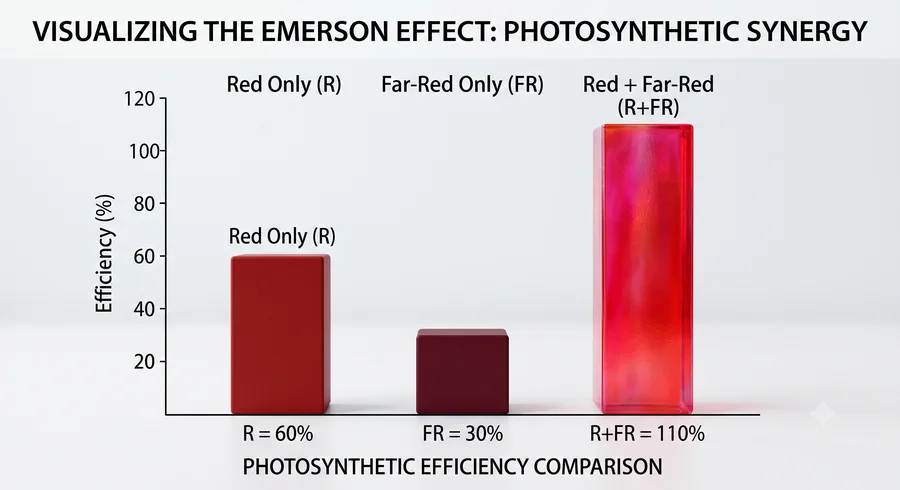
What is reliably established: 700–750 nm photons, in the presence of shorter wavelengths, work on a par with ordinary PAR photons. Not as a bonus on top, but as a full part of the flux — an additive, linear contribution. It is in this formulation that the effect holds up in higher plants, and it is on this basis that the extension to ePAR 400–750 nm has been proposed.
Why ePAR is not universally accepted
That proposal has not become a generally accepted standard. The DesignLights Consortium — the organisation whose qualified products list underpins energy programmes in North America — published a paper in 2021 titled "Limitations of Predicting Far-Red's Effect on Photosynthesis" and kept only the 400–700 nm range in its efficacy calculation.
The DLC argument: the magnitude of the effect depends on the spectrum of the accompanying light and on the specific far-red wavelength, so a single coefficient for all cases is not defensible. Zhen and colleagues published a detailed reply in Frontiers in Plant Science arguing for the linearity of the effect. The dispute is not closed, and this is worth keeping in mind when reading lamp specifications: the ePAR figure is always higher than the PAR figure for the same fixture, and that does not always mean the plant receives correspondingly more. In practice ePAR and PAR for a grow light differ by a few percent and do not change the picture much.
I will add my own view as the author: I treat decisions by standards bodies with reserve. Certification always creates a barrier to entry, and barriers favour whoever is already inside — compliance costs are trivial for a large manufacturer and material for a small one. This is not conspiracy thinking but a mechanism economists have described at length. The DLC's technical reasoning is sound enough, but a standards body's decision and a scientific conclusion are not the same thing, though they are often quoted as if they were.
What a moderate far-red addition gives you
Beyond taking part in photosynthesis, far-red changes the very architecture of the plant, and in moderate doses this works in favour of yield.
Leaf area increases. A plant receiving a little far-red unfolds larger leaf blades. More area means more light intercepted, and therefore more photosynthesis overall, even without increasing lamp intensity. An indirect but noticeable contribution.
Flowering timing shifts — but in opposite directions for different crops. The phytochrome signal takes part in determining photoperiod through the FT and CONSTANS signalling pathways. In long-day crops a far-red addition can bring flowering forward by several days. In short-day crops the effect is the reverse: far-red can delay flowering. This is a fundamental fork, and experience with one group of crops cannot be transferred to another. It considerably complicates any universal use of 730 nm LEDs in grow lights.
The plant opens up slightly. Slightly longer petioles, a slightly more spread canopy — light reaches the lower tiers instead of being absorbed entirely by the top. But this only works with careful dosing and, preferably, a separately controlled far-red channel.
It is worth noting that the biomass gain from far-red comes from two independent contributions, and they are often confused. The first is direct: the 700–750 nm photons themselves take part in photosynthesis when a background of shorter wavelengths is present. The second is indirect, through morphology: a larger leaf intercepts more light, and the plant gains more energy even from an unchanged lamp. In trials on lettuce and tomato the indirect contribution sometimes outweighs the direct one, particularly at early stages before the canopy closes.
A word on the energetics. A 730 nm photon carries less energy than a 660 nm photon, so in theory, at equal chip efficiency, the same watt yields roughly 10% more far-red photons. In practice, however, 730 nm LEDs still lag behind the best 660 nm deep reds in wall-plug efficiency, and by actual µmol/J the red ones usually come out ahead. So far-red is worth adding for its biological action, not to economise on photons.
There is a third effect that is often read too optimistically. Far-red is poorly absorbed by an individual leaf: a significant share reflects off or passes straight through — easily verified with a spectrometer. From this people conclude that far-red "penetrates the canopy" and lights the lower tiers.
Formally the light does reach them. But far-red on its own barely drives photosynthesis: it works only in company with shorter wavelengths. So for the lower tiers a benefit appears only where ordinary PAR also arrives. In a dense canopy that PAR no longer penetrates, far-red alone does not solve the problem — and relying on it as a means of lighting the lower canopy is a mistake.
Where the benefit turns into a problem
Plants have an evolutionarily tuned programme — the shade avoidance syndrome. When phytochrome registers a sharp shift towards far-red, the plant concludes it has been shaded by neighbours and must grow upwards urgently or be left without light.
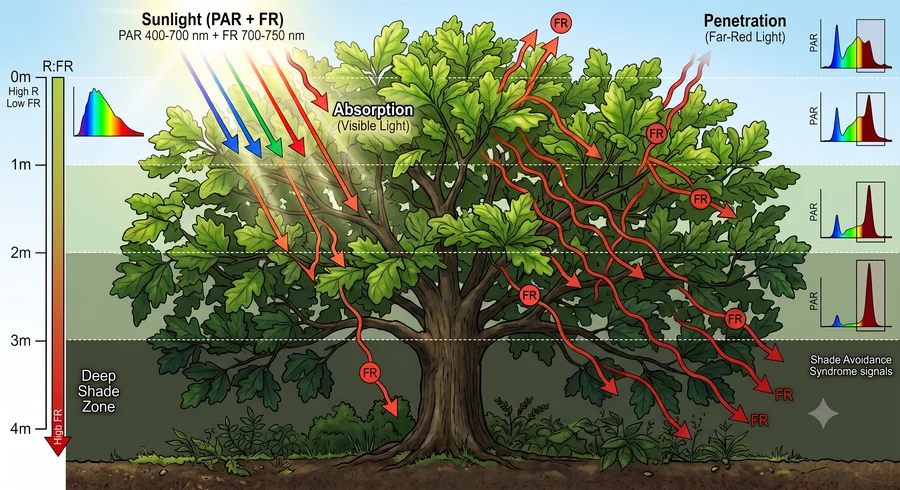
In a forest the logic is flawless. An upper-tier leaf absorbs red and transmits far-red, so beneath the canopy R:FR falls to 0.2 and below while the far-red fraction climbs above 50%. The plant extends its internodes, sacrificing stem thickness and leaf density for height.
In a grow tent this programme fires for nothing. There are no neighbours, but if the far-red fraction is high the plant stretches anyway, losing compactness and strength. The result is a long weak stem — exactly what the grower does not want.
Hence a practical conclusion that is often stated incorrectly. The point is not that far-red is harmful. The point is the dose: at sunlight levels it is beneficial, while at fractions typical of dense shade it triggers an unwanted programme. The balance between full spectrum and far-red therefore matters a great deal.
How much far-red do you need
Take nature as your reference. In open sunlight the far-red fraction is roughly 15–17% of PAR, and that is the range plants are evolutionarily adapted to. Lamps with a 5–15% addition sit in the safe zone: they gain in photosynthesis and leaf area without a stretching risk. That said, adding 10–15% is not economically sensible — 5–10% is realistically enough. To visually analyze the PPFD level of sunlight at different times of the year↗ and at different latitudes, we created an educational interactive widget.
An ordinary grow light without dedicated LEDs delivers 0–4%, which is below the natural level, and plants under it grow more compact than usual. For seedlings that compactness is even useful; for mature plants it is a small missed opportunity.
Above 30–35% you enter territory where the shade signal becomes pronounced. And at 50% and higher the plant is firmly convinced it is shaded, with all that follows.
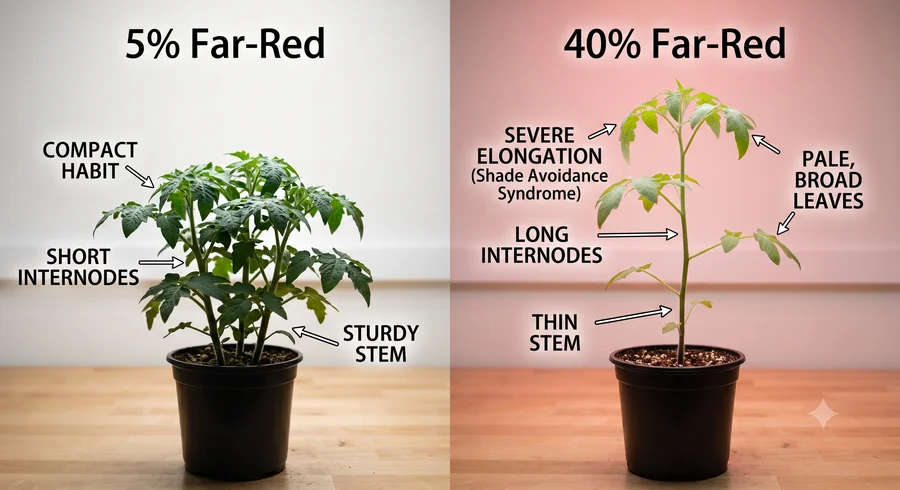
The response also depends on the crop, and no single figure fits all. Lettuce and leafy greens respond to far-red with marked leaf growth, and for them the addition is particularly worthwhile — most of the convincing data comes from leafy crops. Plants with naturally long internodes stretch more readily, so their safe threshold is lower. And during propagation far-red is often deliberately restricted: there compactness matters more than growth, and stretched seedlings are simply a defect.
Manufacturer behaviour is telling. The same brand may fit 730 nm LEDs in fixtures for its leafy line and leave them out of models aimed at crops where stretching and delayed flowering are unwanted. This is not inconsistency but exactly the point: far-red is a tool for a specific job, not a universal spectrum upgrade.
Timing matters too. There is work showing that a short burst of far-red at the end of the photoperiod — so-called end-of-day far-red — produces a morphological effect at very little energy cost, because phytochrome switches in minutes rather than hours. That is fine tuning, but it shows far-red works through its regime as well as its quantity.
Summary: typical values for different sources
To bring all of this together, here are indicative values for the main light sources. Use them as a reference rather than as exact constants: the specific figures depend on the lamp model and on whose coefficients are used to calculate PSS.
| Light source | R:FR | PSS | Effect on the plant |
|---|---|---|---|
| Deep shade under a canopy | < 0.2 | 0.10–0.30 | Strong stretching, weak stem, thin leaves |
| Incandescent lamp | ≈ 0.7 | 0.60–0.65 | Moderate stretching, promotes flowering in long-day crops |
| Natural sunlight | ≈ 1.1–1.2 | 0.70–0.72 | Balanced natural growth — the reference point |
| Standard white LED | high | 0.80–0.85 | Very compact plants, short internodes |
| Pure red LED 660 nm | ∞ | ≈ 0.88 | Maximum conversion of phytochrome to the active form |
Note the incandescent lamp. A large share of its output falls in the far-red and infrared, so its PSS is low — roughly as in light shade. This is precisely why old photoperiodism experiments used incandescent lighting: it delivered a strong far-red signal that fluorescent lamps could not provide.
And a note on the first row: the 0.10–0.30 values apply to genuinely deep shade, where red has been almost entirely stripped out. Under a sparse canopy, or shading by a single tier of leaves, PSS stays higher — around 0.4. The model in the widget is built for exactly this moderate shading, which is why the "In shade" preset shows a value above the table minimum.
Why PSS is not a universal metric
For a long time PSS was regarded as the main way to describe the phytochrome signal. In 2020–2021, however, Bugbee's group examined its limitations in detail, and the picture turned out to be more complicated.
First, calculating PSS requires phytochrome photoconversion coefficients, and different studies publish noticeably different sets. The same spectrum in different hands yields different numbers.
Second, there is not one phytochrome — a plant has several types with different functions, while the PSS model treats them as a single entity.
Third, the light is distorted before it even reaches the phytochrome: chlorophyll in the upper leaf layers strips out red more strongly than far-red, so inside the leaf the ratio is no longer what it was outside.
This is why the simple far-red fraction was proposed as a more reliable indicator. It requires no contested coefficients, is calculated unambiguously from the spectrum and, according to the research, better predicts actual changes in morphology. PSS is not thereby abolished — it remains useful for understanding the mechanism, it simply stops being the only reference point.
How to see the far-red effect for yourself
The widget above lets you assemble a spectrum from four channels and see all the metrics at once. Pick a preset — sunlight, an ordinary full-spectrum lamp, a lamp with far-red added, bi-color, HPS or light in shade — and compare the values. For the sunlight and HPS presets a real measured spectrum is drawn over yours as a dashed line, so you can see how closely four LED channels can approach an actual source.
Then move the far-red slider and watch the two scales. PSS will fall, the far-red fraction will rise, and the plant on the right will begin to change shape — from compact to stretched. That is the transition described above: benefit first, shade signal after.
A useful exercise: set the ordinary lamp preset and add far-red until the fraction reaches the solar 15%. Watch how the effective flux changes — the increase shows by how much ePAR exceeds PAR.
The short version
Far-red stopped being considered useless because, in the presence of shorter wavelengths, its photons work in photosynthesis on a par with PAR — which is what the shift to the ePAR 400–750 nm range is built on.
A moderate far-red addition increases leaf area, improves light interception and can shift flowering timing. It becomes harmful not in itself but at a high fraction, when the shade avoidance programme kicks in.
The reference for a lamp is the natural 15% of PAR, with a sensible working range of 5–10%. Below that is a missed opportunity; substantially above it is a stretching risk.
On the Emerson effect, remember the essential part: what is established is the equivalence of far-red photons given a PAR background. The classic super-additive gain was obtained on algae, has not been shown for higher plants, and claims along the lines of "far-red delivers photosynthesis beyond the sum" require evidence from whoever makes them.
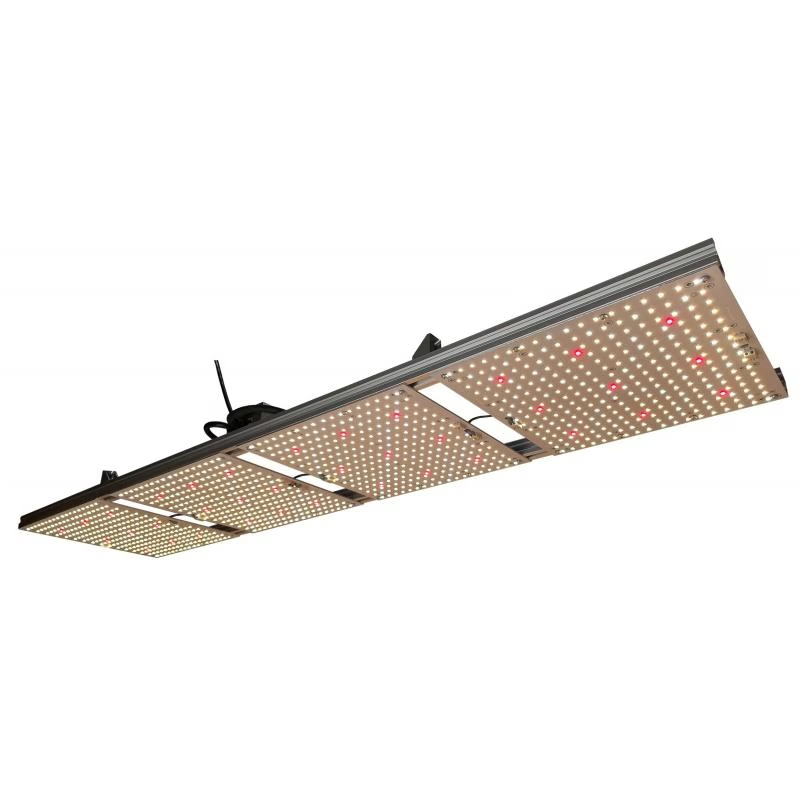
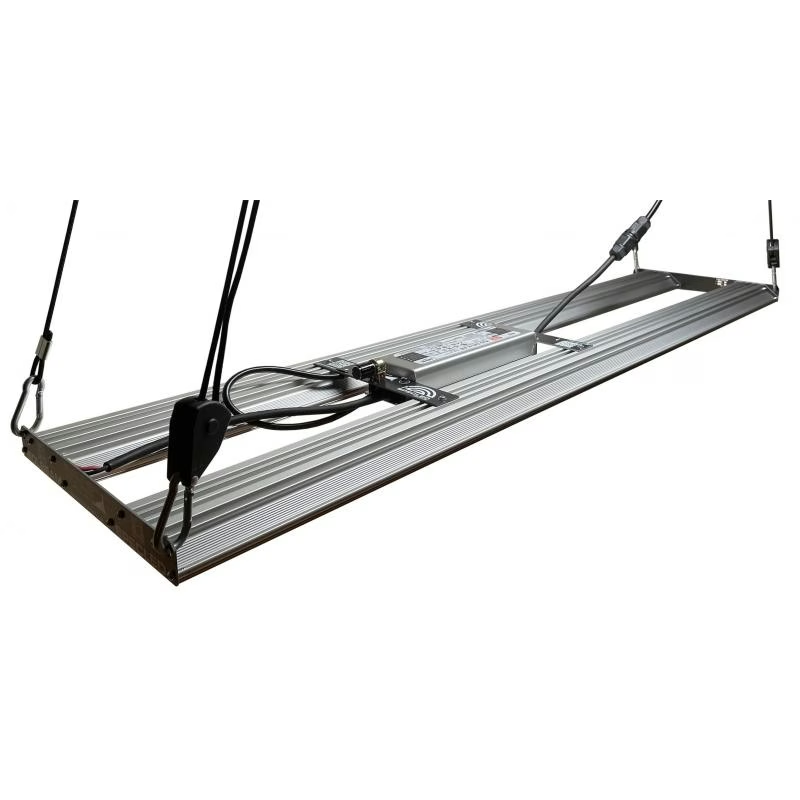
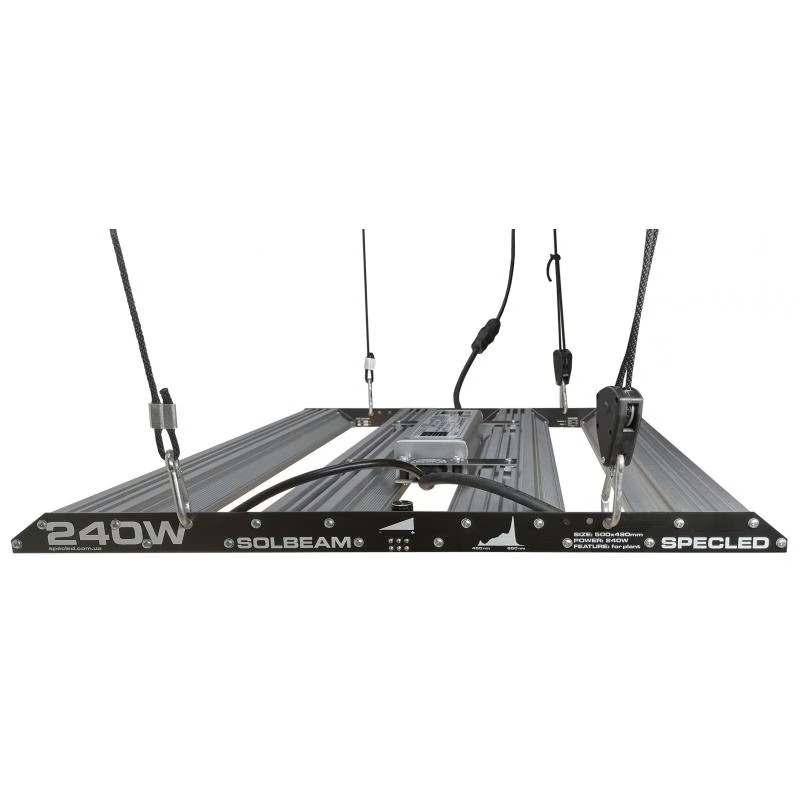
Some of our grow lights or LED modules may have additional 730nm LEDs in a small ratio. Here is an example of a classic full spectrum grow light with added 730nm LEDs:
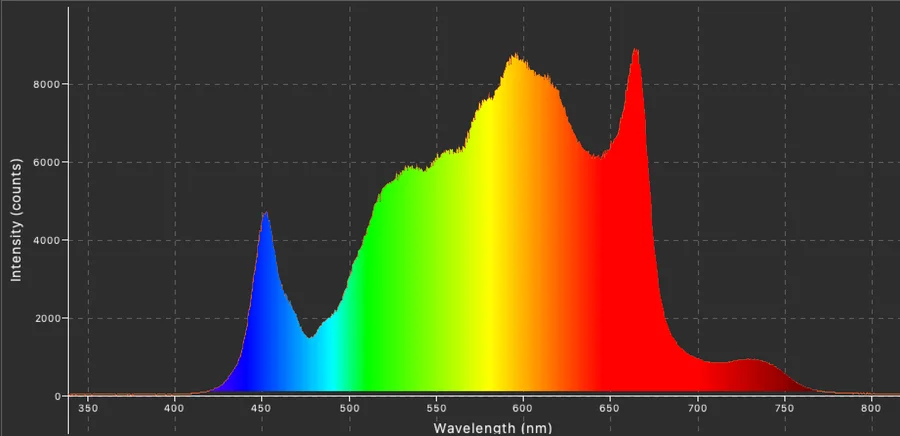
And finally: spectrum calculations give an estimate, not a guarantee. The response depends on the crop, the cultivar, light intensity and growing conditions. The widget shows the direction; the decision always rests on observing the particular plant.
To help train and understand LED module design processes, we created a spectrum simulator for LED grow lights↗ with McCree curve comparison. The simulator features preset standard spectra and six channels of manual spectrum adjustment.