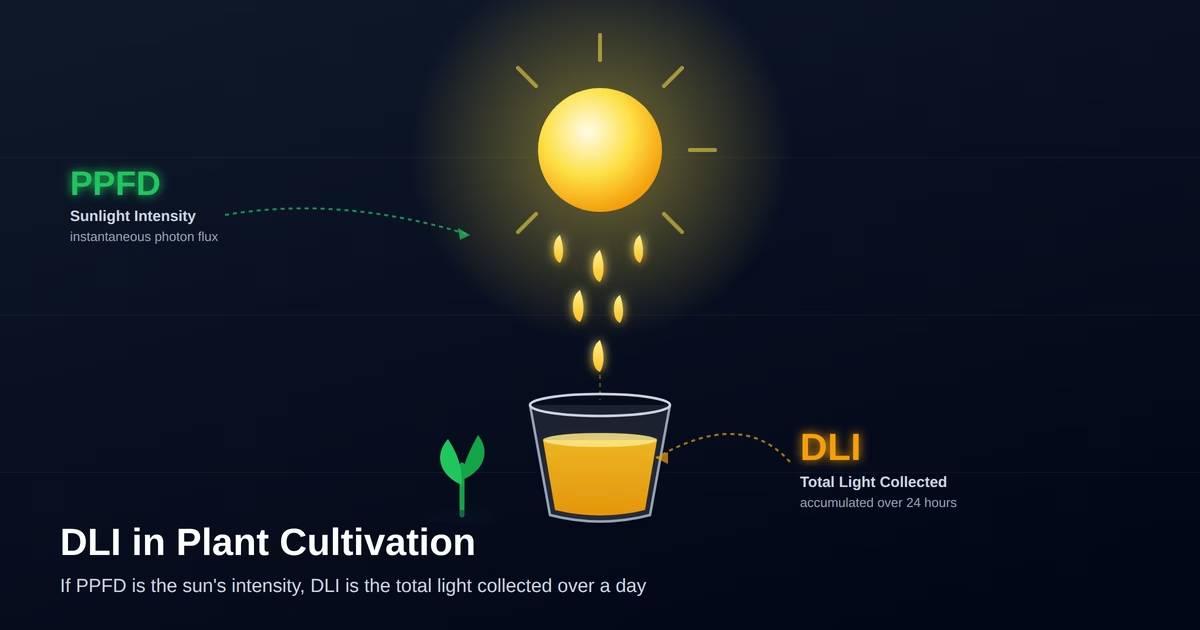
A grow light's specification tells you how brightly it shines. It does not tell you whether that is enough. The number that answers the second question is the daily light integral, and the calculator above turns any pair of settings — lamp strength and hours on — into it.
What DLI actually measures
Daily light integral is the total count of photosynthetically active photons landing on a square metre over a full twenty-four hours. It is written as mol/m²/day — moles, not micromoles. That distinction matters, because the other number on every grow-light page is measured in micromoles and a million of those go into one mole.
The two figures answer different questions:
| What it measures | Units | Timescale | |
|---|---|---|---|
| PPFD | how hard the light is falling right now | µmol/m²/s | this instant |
| DLI | how much fell in total | mol/m²/day | the whole day |
If you have not met the first one before, PPF and PPFD↗ covers where it comes from and how it is measured — everything below assumes you know that a quantum sensor counts photons rather than brightness.
Rain and a bucket
The clearest way to hold the two apart is to think of light as rain.
PPFD is how hard it rains. A drizzle or a downpour, measured at the moment you look.
The photoperiod is how long it rains. Six hours or twenty.
DLI is what ends up in the bucket. A gentle drizzle all day can leave more water than a cloudburst that passes in ten minutes.
That is the whole idea, and it carries a consequence people find surprising: the same daily total can be reached in more than one way. A thousand micromoles for twelve hours and five hundred for twenty-four both come to 43.2 mol/m²/day. The plant, over the day, receives the same amount of light.
PPFD to DLI: the arithmetic
The conversion is one multiplication:
DLI = PPFD × hours × 0.0036The constant is not arbitrary. There are 3600 seconds in an hour, and a million micromoles in a mole, so 3600 ÷ 1,000,000 = 0.0036. Multiplying by it converts micromoles per second into moles per day and nothing else happens.
Worked through for common settings:
| PPFD | 12 h | 16 h | 18 h | 20 h | 24 h |
|---|---|---|---|---|---|
| 200 | 8.6 | 11.5 | 13.0 | 14.4 | 17.3 |
| 400 | 17.3 | 23.0 | 25.9 | 28.8 | 34.6 |
| 600 | 25.9 | 34.6 | 38.9 | 43.2 | 51.8 |
| 800 | 34.6 | 46.1 | 51.8 | 57.6 | 69.1 |
| 1000 | 43.2 | 57.6 | 64.8 | 72.0 | 86.4 |
Read down a column and you see what more light buys you. Read across a row and you see what more hours buy you. They are interchangeable in this table — but not, as we will see, in the greenhouse.
DLI chart: how much different crops need
Requirements differ enormously. Shade plants want a drizzle; fruiting tomatoes want a downpour that lasts most of the day.
| Crop | DLI, mol/m²/day | Stage |
|---|---|---|
| Microgreens, orchids, shade foliage | 6 – 12 | whole cycle |
| Lettuce, basil, culinary herbs | 12 – 17 | vegetative |
| Cucumber, pepper, strawberry | 22 – 30 | flowering and fruiting |
| Tomato and other high-light crops | 30 – 40+ | peak flowering, often with CO₂ |
Treat these as the middle of a broad range rather than as thresholds. Published DLI for plants figures vary between sources by several units in either direction, and sensibly so. Cultivar, temperature, nutrition and CO₂ all move them, and a plant grown cool will use less light than the same plant grown warm.
The floor: why a weak lamp can never get there
Here is the part the rain metaphor hides. Hours and intensity look interchangeable in the table above, but hours run out. There are only twenty-four of them, and most crops need some darkness.
Turn the formula around and ask what PPFD is required to reach a given daily total:
| Target DLI | at 24 h | at 18 h | at 12 h |
|---|---|---|---|
| 12 | 139 | 185 | 278 |
| 17 | 197 | 262 | 394 |
| 22 | 255 | 340 | 509 |
| 30 | 347 | 463 | 694 |
| 40 | 463 | 617 | 926 |
A lamp delivering under 350 µmol/m²/s at the canopy will never reach a tomato's DLI of 30, no matter how long you leave it on. Even running continuously it falls short, and running continuously is not an option for a tomato anyway. No amount of patience substitutes for a fixture that is simply too small for the space.
This is the single most useful thing the calculator does: it tells you, before you buy, whether the lamp you are looking at can reach the number your crop needs in the hours you are willing to run it.
Does every plant need a night?
Not every one, and the common advice that they all do is too broad. Lettuce, many leafy greens and several herbs grow perfectly well under continuous light, and commercial growers use it. Tomato, potato and pepper do not: under twenty-four-hour light they develop interveinal chlorosis and leaf damage within a couple of weeks, a species-specific injury rather than a general rule.
So before stretching the photoperiod to compensate for a weak lamp, check whether your crop tolerates it. Often the honest answer is a bigger fixture.
The sky, for scale
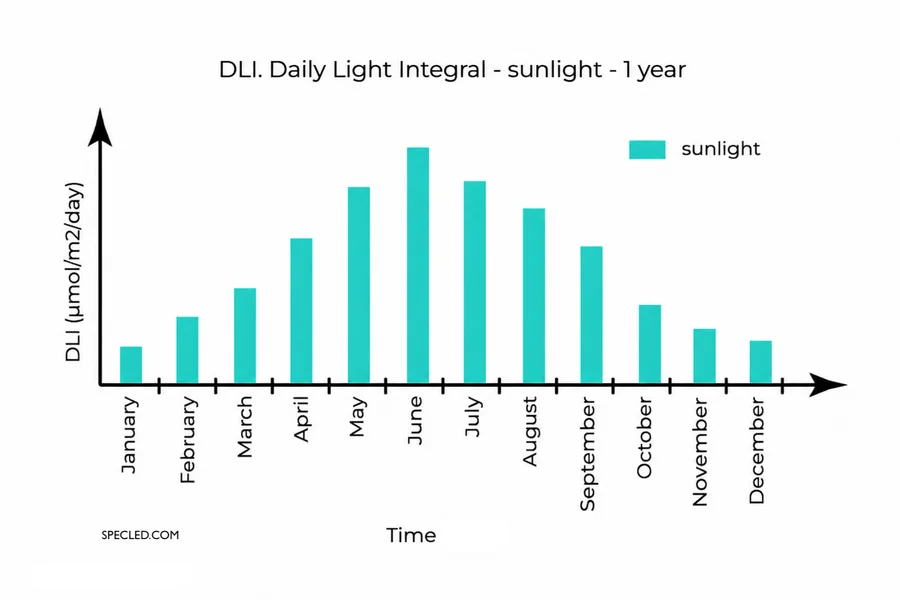
Numbers like "30 mol/m²/day" mean little until you have something to compare them to. Outdoors is the obvious reference, and most people already have an intuition for it:
| Condition | DLI, mol/m²/day |
|---|---|
| Clear summer day, mid latitude | 45 – 60 |
| Overcast summer day | 15 – 25 |
| Clear winter day | 5 – 15 |
| Overcast winter day | 1 – 5 |
| Bright office interior, ten hours | around 0.2 |
Two things fall out of this table.
A south-facing windowsill in December delivers less than lettuce needs, and much less once the glass and the angle of the sun have taken their cut. That is why seedlings on a windowsill in midwinter stretch and go pale: they are not being starved of nutrients, they are being starved of photons.
And a bright room is not dim daylight — it is nowhere near it. An office lit to a comfortable 500 lux gives a plant roughly a two-hundredth of an overcast winter day. Rooms are lit for eyes, not for photosynthesis, and the two have almost nothing to do with each other.
We've also created an educational widget so you can see how much light the sun provides: PPFD and DLI by latitude, season, and cloud cover↗. We recommend reading it.
Too much light
There is a ceiling as well as a floor, though it behaves differently from the way it is usually described.
Photosynthesis does not stop when light gets too strong. It saturates: past a certain point each extra photon produces less additional sugar than the one before, until the curve is nearly flat and you are paying for electricity that does not become growth. Where that point sits depends on the crop, on temperature, and above all on CO₂ — at ambient 400 ppm most plants saturate far earlier than they do at the 1000–1200 ppm a supplemented greenhouse runs.
Beyond saturation, genuine damage is possible. Photoinhibition and photobleaching are real, and leaves exposed to far more light than they can process will lose chlorophyll and bleach. But what growers usually call "light burn" is more often heat. A fixture hung close enough to deliver a very high PPFD is also close enough to warm the leaf surface by several degrees, and the symptoms of heat stress and photodamage look alike from a distance. Before blaming the photons, put a thermometer at canopy height.
The practical version: if you find yourself above a crop's stated range and seeing no benefit, the answer is usually to raise the fixture or shorten the day rather than to add nutrients.
What DLI does not tell you
It is one number, and one number cannot describe a growing environment.
It says nothing about spectrum. Two lamps delivering an identical DLI can have completely different spectra, and the plant will not respond identically to them.
It says nothing about distribution. A DLI averaged over a tent tells you nothing about whether the light is spread evenly or piled into a bright patch in the middle. Corners at half the average are common and are not visible in the daily total.
It says nothing about whether the plant can use the light. This is the one people miss. Photosynthesis needs open stomata, and stomata close when the air is too dry or too humid for the leaf temperature. A perfect DLI delivered into the wrong humidity is partly wasted, because the plant shuts the door on the CO₂ it needs to pair with those photons. The VPD calculator↗ covers that side of the environment — light and vapour pressure deficit are the two halves of the same question, and getting one right while ignoring the other is a common and expensive mistake.
It says nothing about cost. Two schedules with the same DLI do not cost the same. A weak lamp running twenty hours draws its driver losses and its fans for twenty hours; a stronger one running ten does not. Where electricity is expensive, the shorter day is often cheaper for the same daily total — provided the crop tolerates the higher intensity.
Frequently asked
How do I use the DLI calculator to size a lamp? Set the photoperiod you intend to run, then raise the PPFD slider until the daily total lands in your crop's range. The PPFD you arrive at is what the fixture has to deliver at the canopy, not what the box claims at the diode — mounting height and spread both take their cut before the light reaches a leaf.
What DLI does medical tomatoes need? Broadly 20–30 during vegetative growth and 35–45 in flower, with the upper end only worth chasing with supplemental CO₂. As with any crop these are starting points, not settings.
Can I just measure lux and convert? Only roughly, and only if you know the spectrum. Lux is weighted for human vision, which is nearly blind to the deep red that plants use heavily. A conversion factor exists for a given white LED but does not transfer to a different one, and it does not transfer at all to a red-and-blue fixture.
My DLI is right but the plants are stretching. Why? Check the distribution before the total. A canopy that averages the right DLI can still have plants at the edge receiving half of it. Then check the spectrum and the photoperiod — stretching is also a response to far-red and to short days.
Does DLI include daylight coming through a window? It should. Greenhouse growers add the two together and run supplemental light only to close the gap, which is exactly why the outdoor figures above are worth knowing.
Is more DLI always better up to the limit? No. Higher DLI raises transpiration and water demand, and pushes the plant harder in every other respect. If temperature, humidity or nutrition cannot keep up, raising the light makes things worse rather than better.
Related
- PPFD and DLI by latitude, season, and cloud cover↗
- What PPF and PPFD are↗ — the instantaneous measurement DLI is built from.
- VPD calculator↗ — whether the plant can actually use the light it is given.