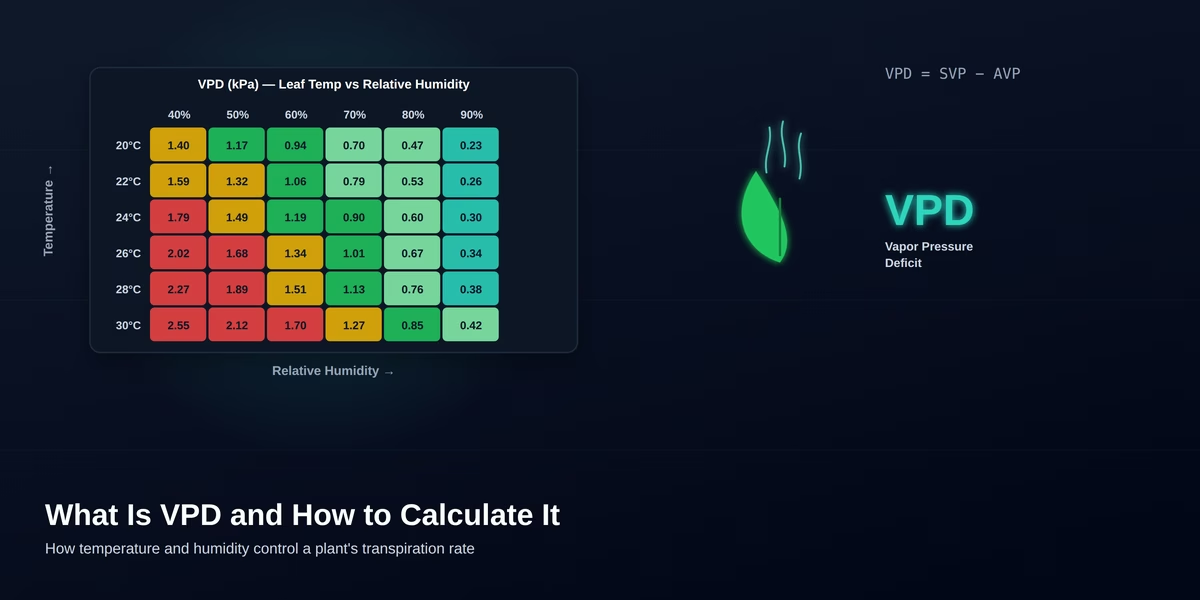
Most growers pick their temperature and humidity from a chart they found online. Plants do not follow charts, though — they follow physics. The law that governs grow room climate is called VPD.
What follows is the abbreviation spelled out, a working definition, the dew point distinction that trips people up, a leaf temperature correction table for every common lamp type, and a full walkthrough of the calculator above.
What Is VPD? Definition and Abbreviation
VPD stands for Vapor Pressure Deficit.
Vapor pressure deficit is the difference between the amount of moisture the air could hold at its current temperature and the amount it is actually holding. It is measured in kilopascals (kPa).
Written out:
VPD = es(T) − e
where es(T) is saturation vapour pressure at the given temperature and e is the actual vapour pressure of the air. The actual value comes from relative humidity: e = es(T) × RH / 100.
One consequence matters more than any other: VPD is not humidity. The same 60 % RH gives 0.83 kPa at 18 °C and 1.70 kPa at 30 °C. Two grow rooms showing an identical hygrometer reading can be entirely different environments for the plant.
The sponge analogy
Think of air as a sponge. A dry sponge — high VPD — pulls water in greedily. A sponge already saturated — VPD of zero — cannot absorb another drop. And the size of the sponge depends on temperature: warmer air is a bigger sponge that holds far more water before it fills.
That is why setting climate "by humidity" does not work. What matters is how far from full the sponge is, and that quantity is VPD.
Dew Point vs VPD: Two Different Questions
Dew point and vapor pressure deficit get confused constantly. They are computed from the same two inputs but answer different questions.
Dew point is the temperature to which air must be cooled before the water vapour in it starts to condense. At that temperature relative humidity reaches 100 %.
| What it tells you | Unit | The question it answers | |
|---|---|---|---|
| VPD | how far the air is from saturation | kPa | how fast the plant transpires |
| Dew point | at what temperature water condenses | °C | where in the room you will get water and mould |
Why dew point matters to a grower specifically. A leaf under LEDs runs cooler than the air. If it drops below dew point, a film of water forms on its surface. Botrytis and powdery mildew start on exactly that film, and at that moment no VPD figure means anything, because the stomata are working underwater.
A worked example from the calculator: air at 20 °C, 90 % RH, leaf 3 K below air. Dew point is 18.3 °C, leaf temperature is 17.0 °C. The leaf is below dew point and condensation is certain. The calculator overrides the VPD verdict in that case and flags the condensation directly.
The same logic applies to any cold surface — tent walls at night, metal ducting, reservoir tanks. Whatever sits below dew point is where the water will collect.
What Vapor Pressure Deficit Actually Controls
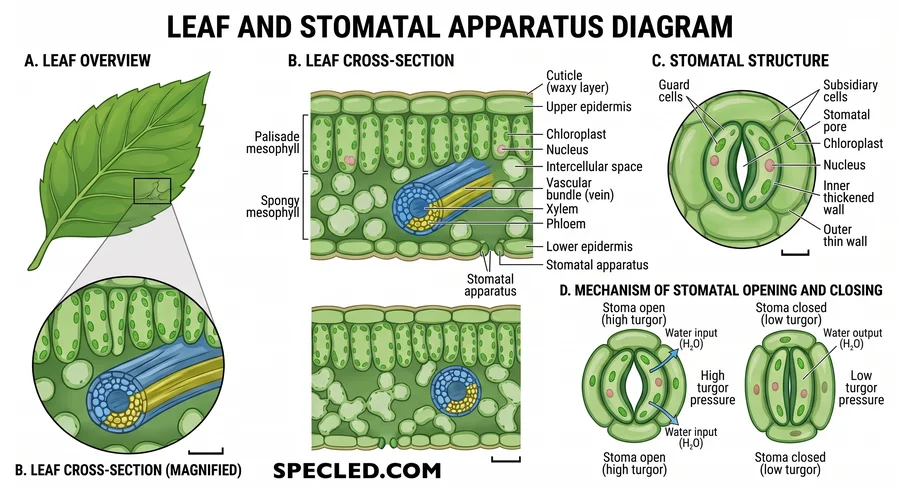
Plants take up water through the roots and release it through microscopic pores in the leaves called stomata. The process is transpiration. A plant is effectively a water pump, and VPD sets the pump's power.
Low VPD — the sauna effect
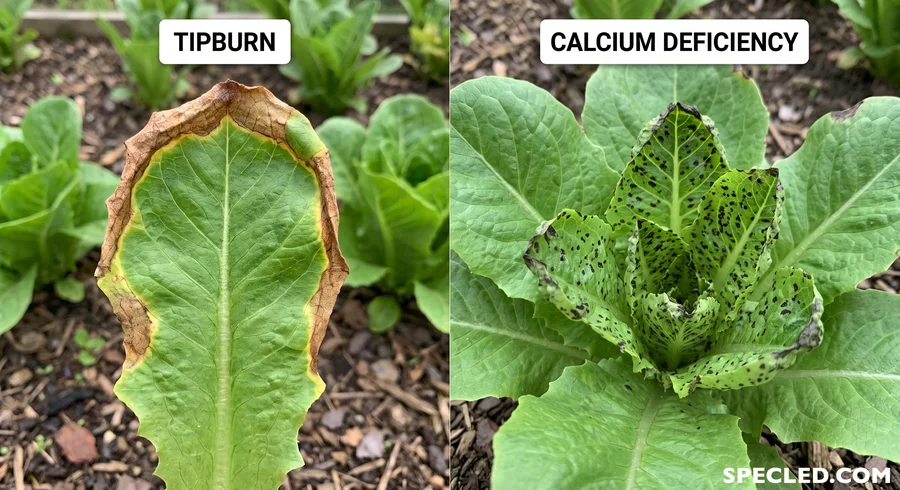
The air is too humid and the sponge is nearly full. The plant cannot evaporate water, so the pump stalls. With it stalls mass flow — the movement of solution from roots to growing points. Because calcium travels almost entirely by mass flow and is barely redistributed through the phloem, calcium is the first thing to fail: young leaves show tipburn even though the substrate holds plenty of it. Dense flowers pick up mould at the same time.
The classic mistake follows from this. A grower sees tipburn, concludes "calcium deficiency", adds a calcium supplement — and makes things worse, because the problem was never nutrition. It was climate.
The optimal band
The plant transpires steadily, cools itself, and pulls fresh solution from root to tip without interruption. Maximum growth rate at minimum stress.
Note that there is no single optimum — the band shifts with growth stage. More on that below.
High VPD — the desert effect
A dry sponge pulls water out of the leaf aggressively. To avoid desiccating, the plant closes its stomata. Here is where the real damage happens: stomata are also the doorway CO₂ uses to enter the leaf. Close them and carbon dioxide uptake stops, and photosynthesis stops with it. The plant stands under full light and physically cannot use it.
If you want to see how light, CO₂ and temperature combine into an actual photosynthetic rate, that interaction is easier to explore on a dedicated tool: plant photosynthesis simulator↗.
VPD Chart: Target Ranges by Growth Stage
A single number for the whole cycle is the simplification that causes most of the trouble. A young cutting with no root system cannot physically sustain heavy transpiration, while a plant in late flower actually benefits from drier air as rot prevention.
| Stage | Target VPD | Reasoning |
|---|---|---|
| Propagation, clones | 0.4 – 0.8 kPa | Almost no roots, nothing to transpire with. A high deficit simply dries the cutting out |
| Vegetative | 0.8 – 1.2 kPa | Root system is working; push for maximum growth rate |
| Flowering | 1.2 – 1.6 kPa | Drier air suppresses botrytis in dense flowers |
These are the ranges in common commercial use. Treat them as a starting point rather than a specification: cultivar, light intensity and root zone conditions all move the optimum.
Light intensity deserves a separate note. The higher the photon flux, the harder a plant can transpire and the higher the VPD it tolerates without stress. Under weak light a high deficit is stress with nothing to show for it. If you are not certain what intensity you are actually running, start here: PPF and PPFD↗ — the difference between the two and how to measure them.
Leaf Temperature Offset: What Separates an Accurate Calculation From a Rough One
The most common error is computing VPD from air temperature. But transpiration happens at the leaf surface, and leaf temperature is almost never equal to air temperature. The difference is called LTO, leaf temperature offset.
The physics is straightforward. Two opposing mechanisms act on the leaf:
- evaporation cools it — water leaving the surface carries heat away;
- absorbed radiation heats it — primarily the infrared part of the lamp's output.
Which one wins depends on the fixture.
| Light source | LTO | Why |
|---|---|---|
| LED | −1.0 … −2.0 °C | An LED sheds most of its waste heat through the heatsink rather than radiating it at the plant. Infrared in the beam is small, so evaporation wins and the leaf works as an evaporative cooler |
| HPS (sodium) | +1.0 … +3.0 °C | A large infrared flux heats the leaf surface directly, and heating outweighs evaporation |
| Metal halide / mercury | +1.0 … +2.0 °C | Less infrared than HPS, but still enough to keep the leaf above air temperature |
| Fluorescent / CFL | 0.0 °C | Very little infrared; leaf sits essentially at air temperature |
| Sunlight (greenhouse) | −0.5 … −2.0 °C | With good ventilation transpiration cools the leaf. In a sealed greenhouse with no air movement it can easily overheat to +3 °C |
To be straightforward about it: these are guide values, not constants. LTO also depends on air movement, distance from the lamp, and how well watered the plant is. The only way to know your real number is to measure leaf temperature with an infrared thermometer and subtract air temperature.
Questions about how to properly measure temperature in a growbox are discussed separately:: measuring temperature in the growbox↗.
How to Use the VPD Calculator
The calculator above handles the physics: saturation vapour pressure from the Buck equation, deficit referenced to leaf temperature, dew point, and absolute humidity. Working order:
Step 1. Measure climate at canopy level. The hygrometer belongs at the top of the plants, not on the floor and not directly under the lamp. Enter air temperature and relative humidity with the two upper sliders.
Step 2. Set the leaf temperature offset. Take a value from the table above or measure it with an IR thermometer. The slider runs both ways: negative means the leaf is cooler than air (LED), positive means warmer (HPS). This single parameter separates an accurate calculation from a rough one, and it redraws the entire chart.
Step 3. Pick the growth stage. The selector switches the target window between propagation, vegetative and flowering. The chart recolours accordingly — what reads green for flowering will read amber for cuttings.
Step 4. Read the result. The large figure is leaf VPD, the gradient the stomata actually work against. Beside it sit the zone badge and the target window for the stage.
The right-hand column carries five values you would otherwise compute separately:
- leaf temperature — air plus offset;
- air VPD — what most online charts show when they ignore the leaf. Compare the two: at 26 °C, 55 % RH under LEDs the difference is 1.14 against 1.51 kPa, roughly a third;
- dew point — if leaf temperature drops below it, the row highlights and the verdict switches to a condensation warning;
- absolute humidity in g/m³ — the figure you size a dehumidifier against, because a dehumidifier removes grams of water, not percentage points;
- RH for mid-band — the most practical line on the panel. The calculator solves the equation backwards and tells you: at your current temperature and offset, set this humidity and you land exactly mid-window.
Step 5. Work the chart. The outlined cell shows where you are. Colours run from teal (too humid) through green (the target window) to amber and red (too dry). Move toward green: horizontally by changing humidity, vertically by changing temperature.
Below the chart the calculator gives a written verdict with a specific instruction — not "too dry", but "raise humidity to 62 % to reach mid-band".
The language switcher in the header covers seven languages if you are sharing the link with colleagues.
Quick Answers
What VPD is considered normal? It depends on stage: 0.4–0.8 kPa for cuttings, 0.8–1.2 for vegetative growth, 1.2–1.6 for flowering. No single figure covers the whole cycle.
Why use VPD instead of plain humidity? Relative humidity says nothing about how fast a plant transpires, because it ignores temperature. VPD accounts for both at once and maps directly onto transpiration.
How do I calculate dew point by hand? Through the inverse Magnus formula. It is easier to read it off the calculator above, which shows dew point next to leaf temperature so you can see immediately whether condensation is coming.
My VPD is fine but the plants still struggle. What now? Check dew point and leaf temperature. Average VPD can look correct while the leaf drops below dew point overnight and wakes up wet.
Do I need a humidifier or a dehumidifier? Look at the "RH for mid-band" line. If the required humidity is above your current reading you need a humidifier; if below, a dehumidifier. Then use the absolute humidity figure in g/m³ to estimate how many litres per day it has to remove.