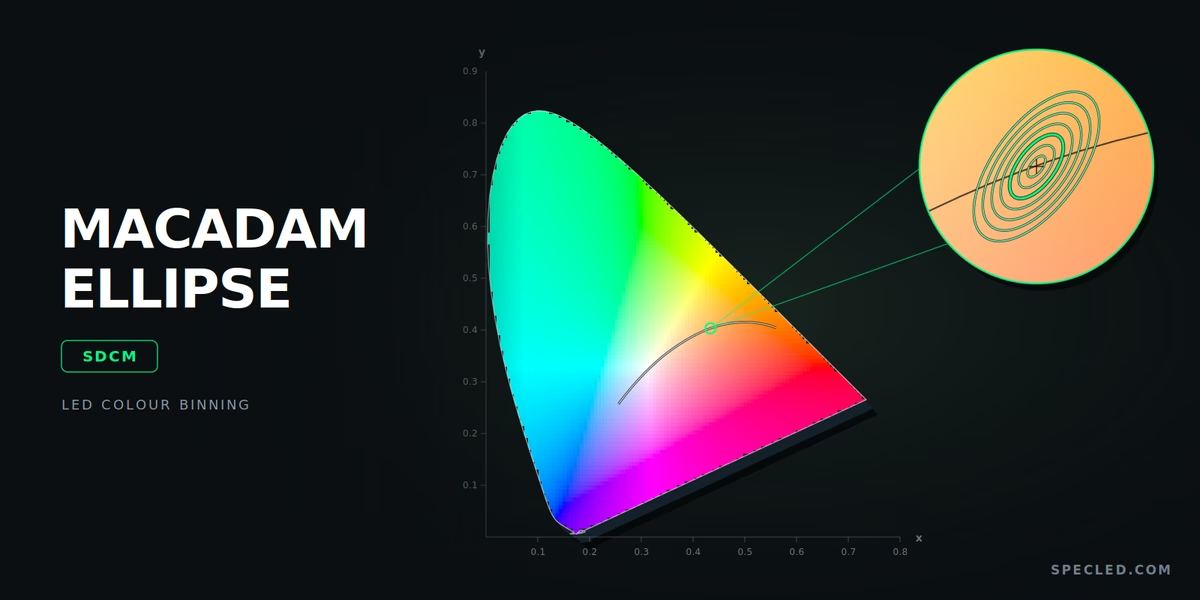
A fixture can hit its rated colour temperature exactly and still look wrong next to its neighbour. The number that predicts this is not the CCT on the box — it is the MacAdam ellipse the manufacturer binned to, quoted as SDCM. This page explains what a step is, why the tolerance is an ellipse rather than a circle, and lets you find your own threshold by eye.
What a MacAdam step is
In the 1940s David MacAdam sat observers in front of a split field of colour and asked them to adjust one half until it matched the other. He plotted where they stopped. The scatter of their settings was not a circle — it was an ellipse, and its size and tilt changed depending on where on the chromaticity diagram he was working.
One MacAdam step is one standard deviation of that scatter. The name SDCM comes from exactly this: standard deviation of colour matching. A one-step ellipse encloses the colours an average observer could not reliably tell apart from the target under ideal, side-by-side conditions.
Put a number on it and the scale stops being abstract. At 3000 K, moving one step from the target is a colour difference of roughly ΔE2000 = 0.55. Two steps lands at about 1.1 — which happens to be the classic threshold at which a difference becomes noticeable side by side. Seven steps, the outer limit of the ANSI grid, is around 3.7, which nobody misses.
| Steps from target | ΔE2000 at 3000 K | In practice |
|---|---|---|
| 1 | 0.55 | Below the threshold of most observers |
| 2 | 1.1 | The classic just-noticeable difference |
| 3 | 1.6 | Visible edge to edge, easy to miss otherwise |
| 5 | 2.7 | Obvious on a shared surface |
| 7 | 3.7 | Obvious anywhere |
Why the tolerance is an ellipse and not a circle
This is the part that trips people up, and it has a clean answer: the chromaticity diagram is not perceptually uniform. Equal distances on it do not correspond to equal differences to the eye.
Try it in the simulator above. Take the 3000 K target and move a fixed distance of 0.0056 in chromaticity coordinates — the same number of millimetres on the chart — in two different directions. Along the long axis of the ellipse that is 2.00 steps. Across the short axis it is 4.09 steps. Same distance on paper, twice the colour shift to the eye.
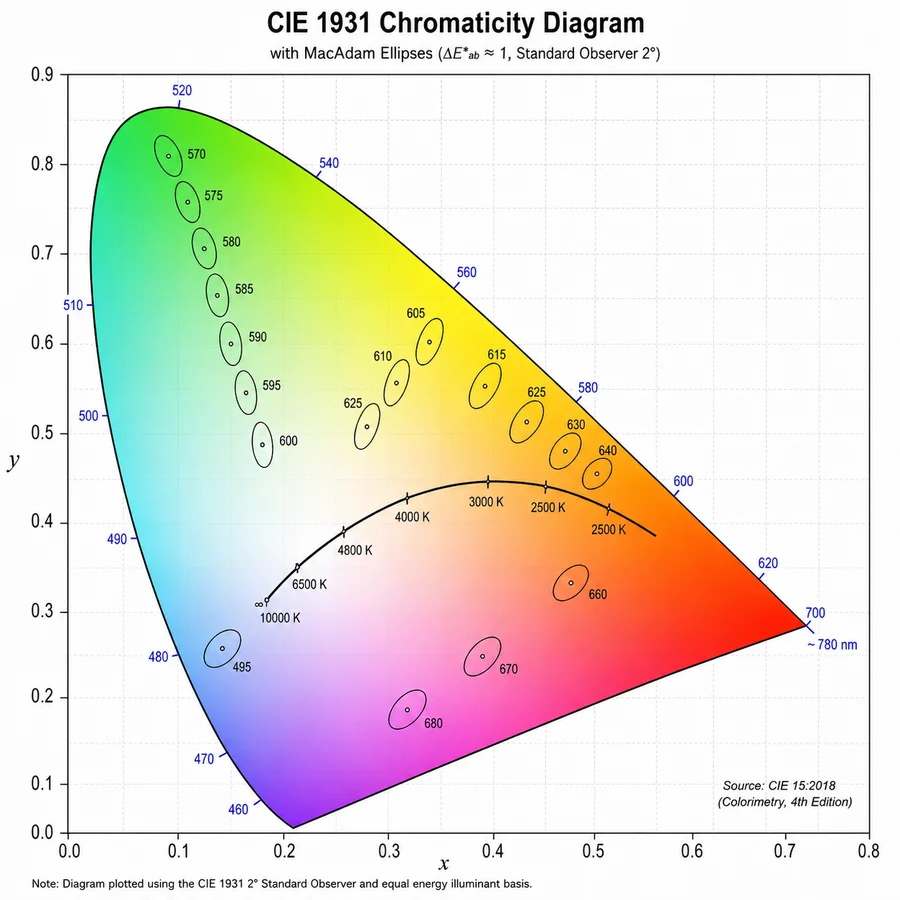
A circular tolerance would therefore be wrong in both directions at once: too strict where the eye is forgiving, too loose where it is fussy. The ellipse is the shape that makes one unit mean one thing regardless of which way you travel.
There is a way to check that this actually works, using a metric that knows nothing about MacAdam. CIE ΔE2000 is an independent model of perceived colour difference. If the ellipse is doing its job, then moving an equal number of steps in any direction should produce an equal ΔE2000 — and it does:
| CCT | Axis ratio in xy | Ratio in ΔE2000 at equal steps |
|---|---|---|
| 2700 K | 1.92 : 1 | 1.32 : 1 |
| 3000 K | 2.04 : 1 | 1.19 : 1 |
| 4000 K | 2.34 : 1 | 1.04 : 1 |
| 5000 K | 2.32 : 1 | 1.04 : 1 |
| 6500 K | 2.56 : 1 | 1.14 : 1 |
A two-to-one stretch in raw coordinates collapses to nearly one-to-one once perception is accounted for. That is the ellipse earning its shape.
One thing the ellipse is not
A tempting explanation, repeated in a fair number of articles, is that the long axis of the MacAdam ellipse runs along the black-body line, so the eye forgives drift towards warmer or cooler while punishing green and pink. It is a satisfying story. It is also wrong.
Compare the ellipse tilt with the tangent to the Planckian locus at the same point: they differ by 41° at 2700 K, 34° at 3000 K, and only converge to within 14° by 6500 K. The tilt of a MacAdam ellipse is a property of colour vision at that position on the diagram, not a reflection of the black-body curve. The green-versus-warm asymmetry is real, but it comes from Duv, which is a separate quantity — see below.
LED binning grades: what 1 to 7 steps buys you
Manufacturers sort production into bins and quote the ellipse each bin fits inside. This is what the grades mean commercially:
- 1 step — laboratory reference. You will almost never see it offered.
- 2 steps — studios, museums, high-end retail, anywhere colour is the product.
- 3 steps — the usual mark of a quality fixture. "3 step MacAdam" on a spec sheet is a real claim worth paying for.
- 4 steps — a decent commercial product.
- 5 steps — mainstream lamps. A wall wash will show it.
- 6 steps — budget product, visible side by side.
- 7 steps — the outer ANSI C78.377 limit. Differences are obvious.
Two cautions. First, a binning claim is about spread within a batch, not accuracy: a 3-step bin can still sit off-centre from nominal, so two 3-step products from different makers may not match each other. Second, LEDs drift with age and temperature, and a tight bin at the factory says nothing about where the fixture will be in three years.
Duv, and why green is worse than warm
Chromaticity has two directions that matter, and people react to them very differently. Moving along the black-body line makes light warmer or cooler — a shift most observers read as intentional. Moving away from that line adds tint: green above, pink below. Duv is the signed distance from the locus, and it is the number that predicts complaints.
The reference points bear this out. ANSI's warm targets sit essentially on the locus: 2700 K comes out at Duv −0.0004, near enough zero. The cool ones drift progressively to the daylight side — 4000 K at +0.0010, 5000 K at +0.0020, and 6500 K at +0.0032. That last one is D65, the daylight illuminant, which is deliberately above the Planckian locus rather than on it.
A tint of ±0.003 is roughly where people start describing light as "a bit green" or "a bit pink" without being able to say why. Hover across the short axis of the ellipse in the simulator and watch Duv change sign — the swatch shifts in a way that reads as wrong rather than merely different.
Chromaticity is only half the story
The MacAdam ellipse answers one question well: are these two sources the same colour? It says nothing about a second question that matters just as much: how well does either of them render the colours it falls on?
If you would like to explore colorimetry in greater detail, we recommend reading our article, which also includes an interactive educational widget that provides a clear visual explanation of the established standards used to evaluate color rendering: CRI and the modern TM-30 method for evaluating color rendering↗.
Two LEDs can land on precisely the same point of the chromaticity diagram and have completely different spectra. One might be a blue chip with a narrow phosphor and a deep gap in the cyan region; the other a violet-pumped source with a smooth, broad output. Identical chromaticity, identical SDCM, and visibly different skin tones and fabrics.
That is the reason spectral quality is a separate specification. If you want to see how spectrum shape and chromaticity interact — including how a source engineered to follow daylight behaves — the SunLike LED spectrum mixer↗ lets you build a spectrum and watch where it lands on the diagram and what Duv it produces. Sun-like sources are a useful test case here precisely because their selling point is the shape of the curve rather than the coordinate it reaches, and tight binning matters more for them, not less: a spectrum designed to be neutral is unforgiving of a tint error on top.
When Binning Really Matters
Not everywhere, and the difference is worth money. It's not always truly important. It's only worth paying for when it makes a noticeable difference.
The single biggest factor is not the size of the shift but whether the two sources are visible at the same time. A three-step difference is easy to see edge to edge, hard to call across a gap, and effectively invisible on separate walls or in separate rooms. The comparison panel in the simulator shows this directly: keep the swatches touching and the difference is obvious, push them apart and it fades.
That gives a practical rule. Spend on tight binning where fixtures share a surface — a run of downlights over a counter, a cove, a wall wash, linear runs in a corridor. Relax it where they do not: scattered ceiling fixtures in a large open space, or lighting in rooms nobody sees side by side.
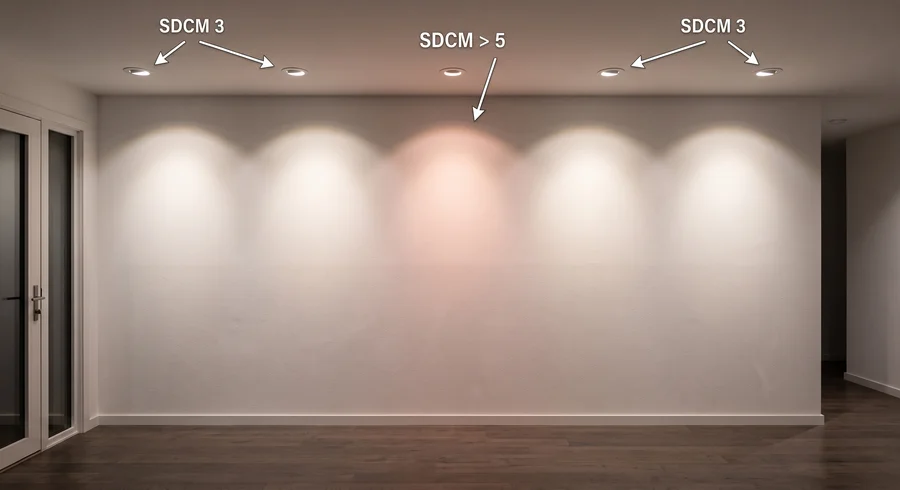
The layout decides this, which means binning is a question you should be asking at the same time as spacing and quantity. If you are working out how many luminaires a space needs and where they go, the indoor lighting calculator to EN 12464-1↗ covers illuminance, uniformity and glare for the room — and the layout it produces tells you immediately which fixtures will end up in each other's field of view, and therefore where a tight bin earns its cost.
What SDCM cannot tell you
It is a human-vision metric. MacAdam ellipses come from human observers matching colours. They carry no information about anything else that light does. Plants respond to photons by wavelength with no reference to how the mixture looks, so a horticultural source can sit far outside any sensible bin and still be exactly right.
It says nothing about colour rendering. Ra and TM-30 are separate specifications, and a fixture can be tightly binned and render poorly.
A screen cannot show you the real thing. The swatches in the simulator are converted from chromaticity coordinates to sRGB with the brightest channel normalised to full. That keeps the hue honest, but the patches are not photometrically matched, your display is not calibrated, and the surround is nothing like a lit room. Treat them as an illustration of the size of a shift, not as a colour reference.
Your own threshold is not universal. The three-patch test in the simulator measures you, on that screen, at that patch size, with the patches touching. Move them apart and your threshold will rise sharply. That is the point of the exercise, not a flaw in it.
Frequently asked
Is 3-step MacAdam good enough? For most commercial and residential work, yes — provided all the fixtures come from the same bin. Where colour is part of the product, or where fixtures share a visible surface, 2 steps is worth the money.
Why do two "3-step" products still not match? Because a bin describes spread around a centre, not the centre itself. Two manufacturers can both hold 3 steps around slightly different nominal points, and the gap between those centres adds to the spread within each.
Is SDCM the same as MacAdam steps? Yes. SDCM stands for standard deviation of colour matching; one SDCM is one MacAdam step. Spec sheets use the terms interchangeably.
What about Duv — is there a rule of thumb? Keep it inside ±0.003 and few people will comment. Beyond that, the green side draws complaints faster than the pink side.
Does binning drift over the life of the fixture? Yes. A factory bin describes the fixture when new. Chromaticity maintenance over life is a separate figure, quoted by better manufacturers and quietly omitted by the rest.
Related
- SunLike LED spectrum mixer↗ — build a spectrum and see where it lands on the diagram.
- Indoor lighting calculator to EN 12464-1↗ — illuminance, uniformity and glare for a room.
- SunLike LEDs in grow lighting↗ — where spectrum shape matters more than chromaticity.