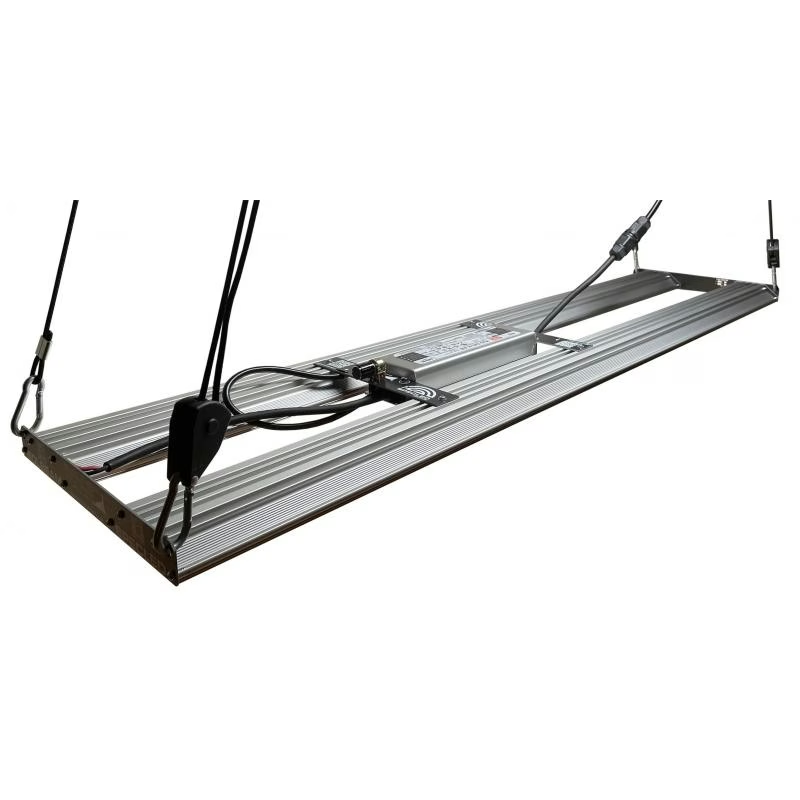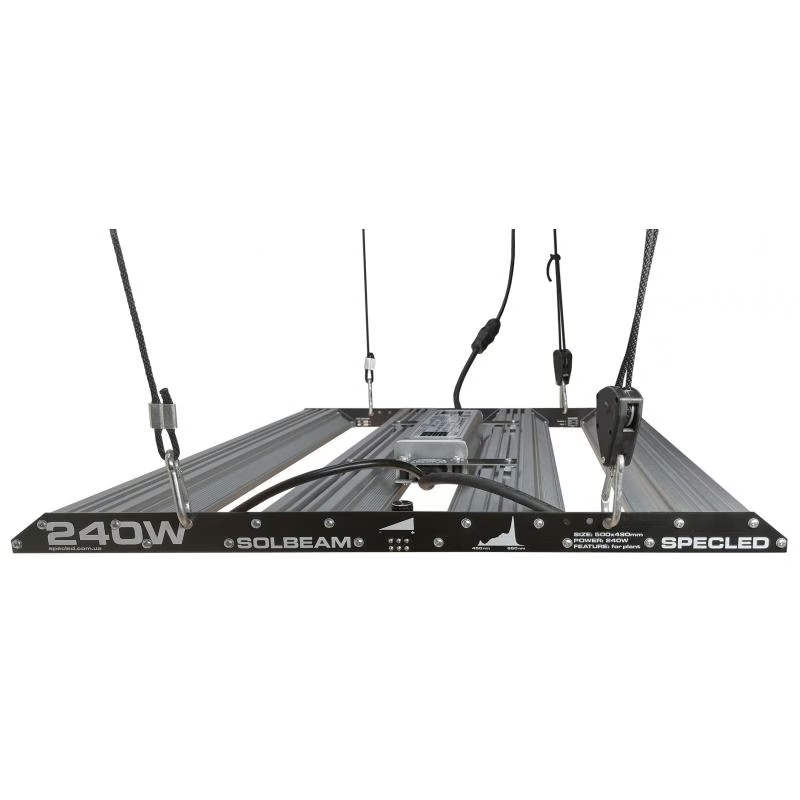
Marketers build the market, not engineers and scientists. To understand what is better: regular white LEDs or non-regular LEDs, we need to remember how it all started in the early 2010s.
Namely, people started making money on LEDs before it was economically viable. But at the same time, many gained invaluable experience by becoming pioneers in this business.
The first LED grow lights were lamps based on powerful 440nm and 660nm LEDs, which had a very high efficiency compared to classic HPS lamps, but only at the vegetative stage. Then time went on, technologies changed, and by 2016 the efficiency of LEDs allowed them to completely replace HPS lamps.
By this time, the average user had already realized that two peaks of 440nm and 660nm were extremely insufficient for the full-fledged cultivation of any plants whatsoever; even lettuce or basil was unfit for consumption if it was grown exclusively under a red + blue spectrum.
In fact, since the 1940s, a huge number of experiments on artificial plant lighting had been conducted, and science knew all the fundamentals of this matter. However, the information was not widely available on the internet, and scientific articles and papers continued to gather dust on shelves in archives and libraries. Due to what was happening, marketing won without a fight and started a new cycle of LED grow light development from simple to complex and back to simple.
Today, in 2026, everyone is already used to the fact that a "sane person's" grow light is a mix of white LEDs with the addition of 660nm, sometimes 730nm, and some other wavelengths. Does this mean that the technology has reached the peak of perfection? And further improvement is only an increase in LED performance, which will reduce their heating while simultaneously increasing the luminous flux? Oh no, I think we still have a long way to go and we will see many interesting but not always successful solutions!
In this article, I want to talk about the SunLike technology developed by the South Korean giant Seoul Semiconductor in partnership with Toshiba Materials. This is not just another generation of white LEDs — it is an attempt to accurately recreate the spectrum of the real sun indoors. The technology is good for lighting residential spaces, but what if we apply the technology to plant lighting? After all, undeniably, the sun is the ideal lighting source for all existing types of plants.
All the information provided below is taken from three official articles published on the Seoul Semiconductor↗ website.
The Physics of Light: What makes SunLike technology unique?
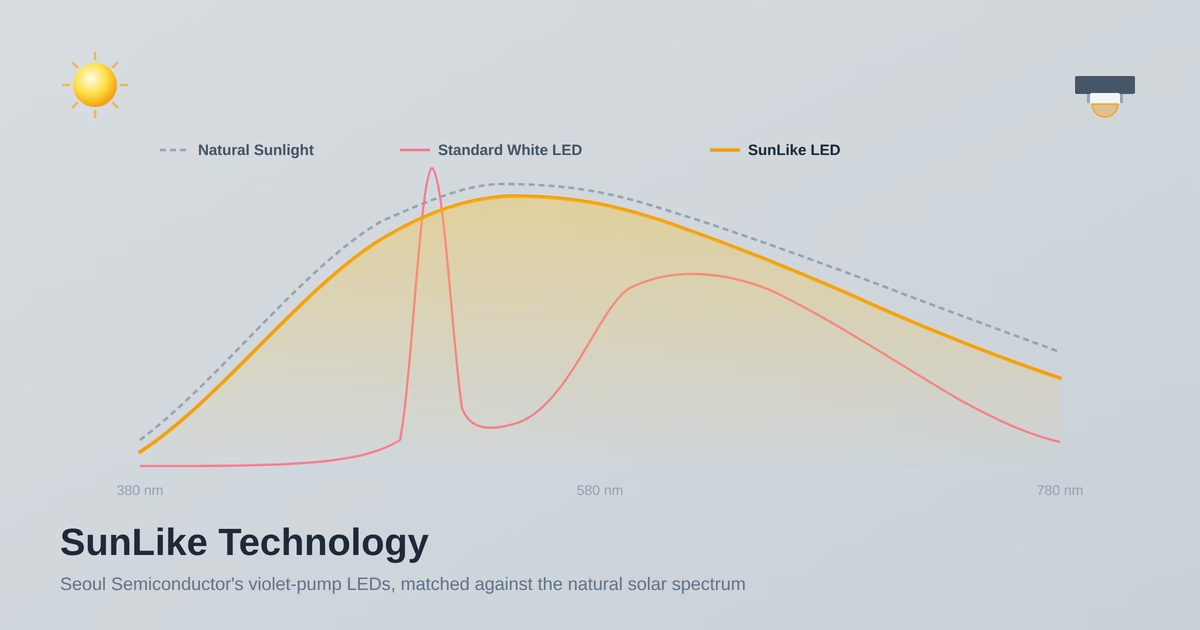
SunLike is a Natural Spectrum LED architecture that generates a continuous spectrum of light, which almost entirely matches the curve of the natural solar spectrum in the visible range, eliminating the toxic peak of blue radiation.
Traditional white LEDs are produced using the same scheme: a powerful blue chip (440nm-455nm) is used, which is covered with a layer of yellow phosphor. The result is white light, but if you look at its spectrogram, you will see an unnaturally huge, aggressive peak in the blue zone and dips (for example, at 500nm) in other ranges that are critically important for living organisms.
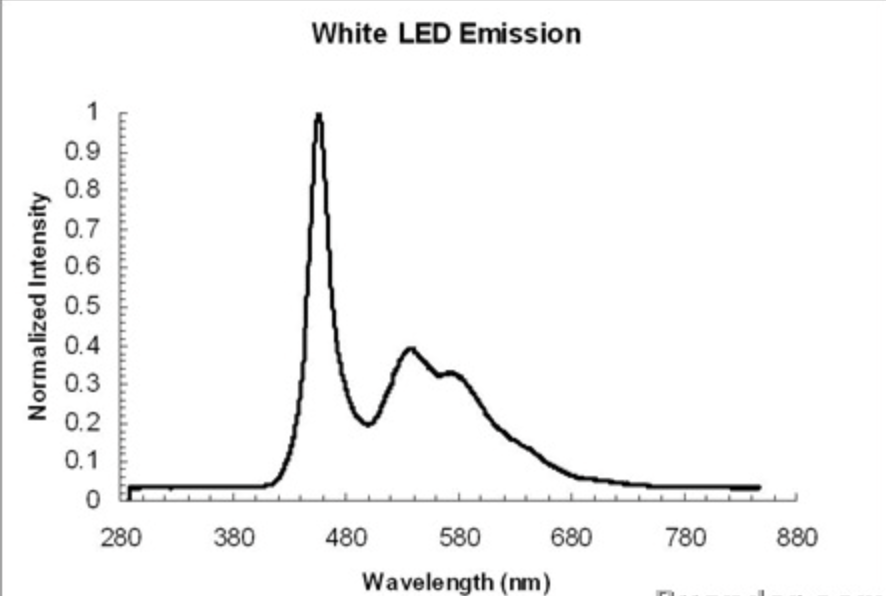 "Spectrum of a regular white LED with a color temperature of about 5000-6500K"
SunLike series LEDs are built on TRI-R® technology. Instead of a blue crystal, a purple (near-ultraviolet) crystal is used here, which excites a complex mixture of three phosphors (red, green, and blue). This architecture radically changes the emission curve:
- It completely rids the spectrum of the aggressive blue peak.
- It provides continuous emission in the widest range of wavelengths — from 380 nm (UV-A) to 740 nm (far-red).
- The Color Rendering Index (CRI) reaches a value of 97 (with standard sunlight being 100), which allows plants to look natural, and agronomists to notice diseases or nutrient deficiencies on leaves in a timely manner.
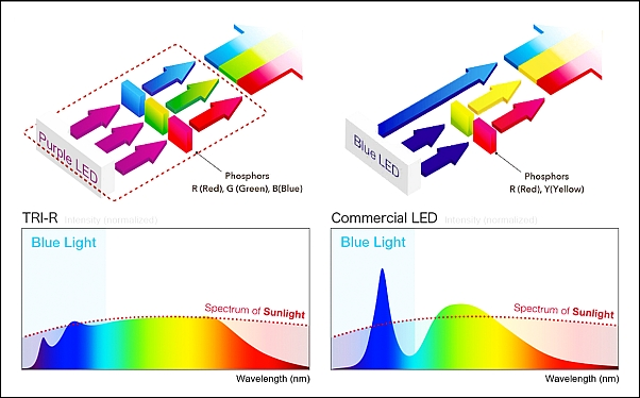 "Comparison of the SunLike LED structure and a classic white LED"
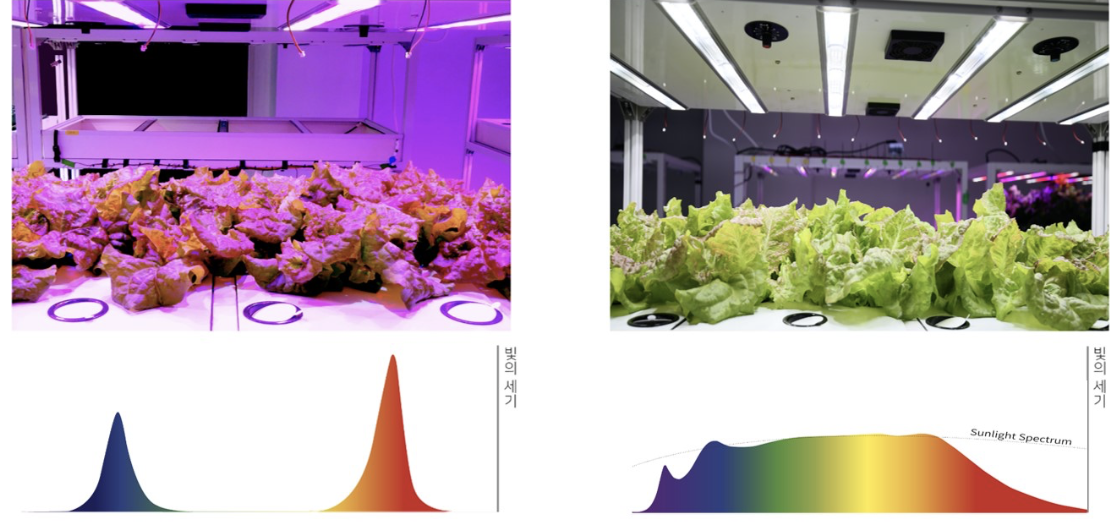
For plants, such a spectrum means the absence of physiological stress and the ability to trigger millions of years of evolutionary mechanisms designed specifically for sunlight.
To advance SunLike technology and other LED technologies with a linear spectrum that closely resembles sunlight, we created an interactive SunLike LED spectrum mixer simulator↗ for visually modeling the spectrum by mixing LEDs with different glow temperatures from 2700K to 6500K.
From Theory to Practice: Lettuce Yield Experiments
To prove the effectiveness of the full spectrum, Seoul Semiconductor has deployed its own research farms, where it has been studying the impact of various light sources on crop growth for the past 10 years. The most revealing were the series of experiments with lettuce — a crop that reacts extremely sensitively to light quality.
During independent tests, researchers established two control groups. The first was grown under standard white LEDs, the second under SunLike LEDs. At the same time, both light sources had absolutely identical color temperature and light intensity (PPFD). The difference lay solely in the quality of the spectrum.
The results after two to three weeks of vegetation exceeded the biologists' expectations:
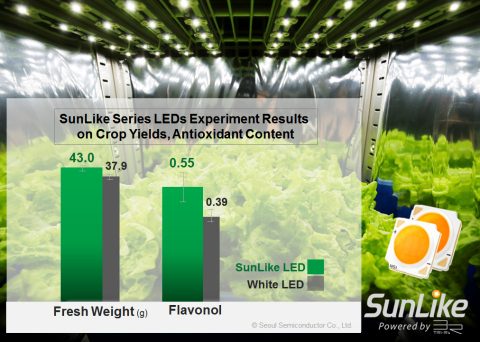
1. Increase in biomass and growth rate: Plants under the SunLike spectrum developed faster. In one experiment, the fresh weight of the lettuce was 43.0 grams, which is 13.5% more than the control group under regular LEDs (where the weight was about 37.9 g). In other variations of the experiment, a stable yield increase of 4% to 14% was recorded.
2. Explosive growth of nutrients and antioxidants: The most important discovery concerned not the appearance, but the internal chemistry of the plants. The spectrum close to solar triggered a powerful production of secondary metabolites:
- The content of flavonols (powerful antioxidants) increased by 41%.
- The concentration of chlorogenic acid skyrocketed by 55%.
- The level of chicoric acid grew by 31%.
For the end consumer, these numbers mean a lot. Chlorogenic and chicoric acids are known for their ability to bind free radicals in the human body, suppress inflammatory processes, slow down cell aging, and reduce the risk of developing arthritis and Alzheimer's disease. In other words, lettuce grown under SunLike turned out to be not just larger, but also significantly healthier. (But does this bother farmers? They just make money. Moreover, the effect of consuming excellent quality lettuce is not obvious).
Recognition by European Science: INRAE and GreenHouseKeeper Projects
Seoul Semiconductor's technology has not gone unnoticed in the highest scientific circles of Europe. In 2021, it became known that SunLike LEDs were chosen to equip the agricultural laboratories of INRAE (The National Research Institute for Agriculture, Food and Environment of France) — one of the most prestigious specialized institutes in the world. At this point, I want to leave links where you can read in detail about:
Equipment in the PHENOPSIS laboratory↗
and why INRAE abandoned the use of classic white LEDs in their laboratory.
INRAE's rejection of ordinary LEDs↗
The project was implemented jointly with the French engineering company GreenHouseKeeper, specializing in automation and smart lighting for research centers. The engineers faced an incredibly difficult task: to create such lighting conditions in a closed laboratory that would allow for the reliable study of the growth and flowering stages of complex crops (for example, sunflower).
The use of SunLike LEDs allowed GreenHouseKeeper specialists to develop dynamic lighting systems capable of accurately imitating the four seasons. INRAE scientists confirmed that only a spectrum as close to solar as possible from the UV to the IR range guarantees that plants in the laboratory will behave exactly the same as in an open field. Ordinary white or red-blue LEDs distorted the results of scientific tests due to the stress reactions of plants to unnatural light.
Commercial Integration and Global Leadership
Success in laboratories quickly transformed into commercial partnerships worldwide. The largest manufacturers of greenhouse equipment actively began integrating Seoul Semiconductor chips into their flagship products.
- In Turkey, which is one of the world's largest exporters of agricultural products, the company Fiberli integrated SunLike chips into its professional grow lights. As Fiberli Director Hakan Öztürk noted, this decision allowed local farmers not only to increase yields but also to achieve consistently high product quality year-round, regardless of the weather outside the greenhouse window.
- In the Netherlands, the recognized global capital of indoor farming, SunLike LEDs are actively used by the company Rofianda B.V. for lighting advanced greenhouse complexes.
- In the US market, the company Innovative Growers Equipment uses a combination of SunLike white diodes with deep red and ultraviolet spectra from Seoul Semiconductor to create ultra-powerful luminaires (up to 600 W). This is especially true for growing light-loving crops where it is required to maximize biomass accumulation and stimulate the production of specific chemical compounds.
Conclusion: The Future Belongs to Photon Quality
The experience and research of Seoul Semiconductor clearly demonstrate a fundamental shift in the philosophy of agrophotonic. If over the last ten years farmers and engineers chased quantitative indicators — reducing energy consumption and increasing pure PPFD (number of photons), today spectrum quality comes to the forefront.
Plants are complex biological mechanisms tuned to the spectrum of our star. Artificial light, even if it is very bright but lacks important transitional wavelengths, leads to disruptions in plant metabolism. SunLike technology has proven that investing in the right, solar spectrum pays off not only by increasing the weight of the harvest but also by radically improving its taste, texture, and nutritional value.
It's been 5 years since 2021, today is June 25, 2026, and the technology still hasn't gained worldwide popularity, at least among home growers and city farm owners. No, no, I absolutely agree, a high-quality spectrum is very important for plants, but SunLike technology is still expensive; near-UV range crystals are produced in smaller quantities (which means they are more expensive) and have lower efficiency than classic 440-455nm crystals. The phosphor for SunLike LEDs obviously costs more than standard ones. The technology has a very high prospect only if the price of SunLike LEDs is reduced and the LED efficiency increases, which is quite realistic from the point of view of physics.