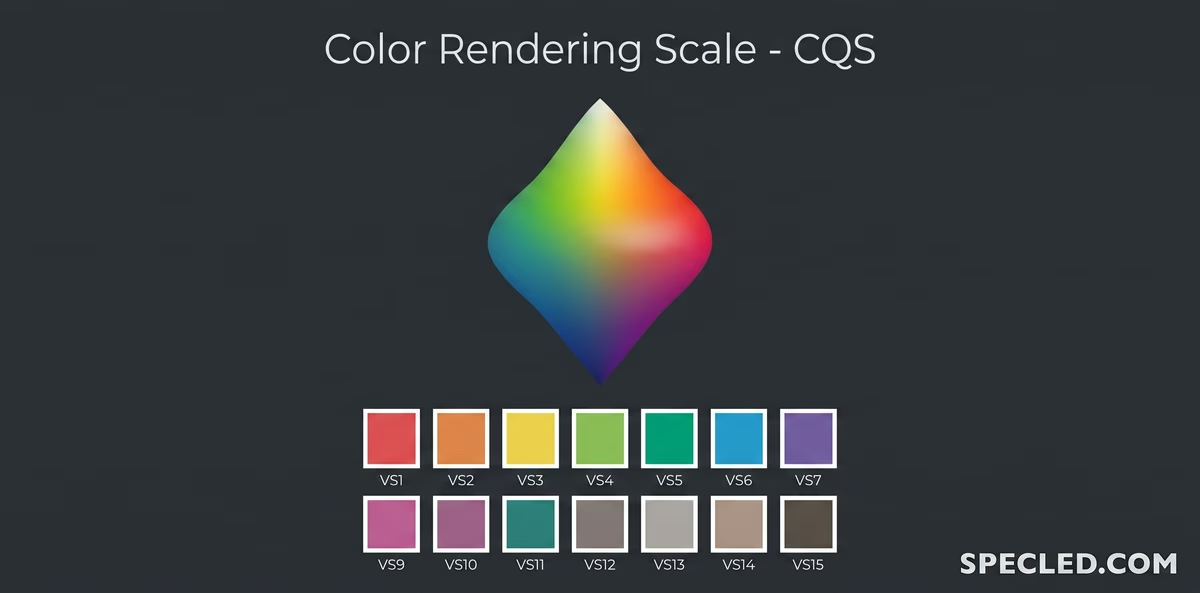
The CQS Color Quality Scale: Why Was It Created?
Since 1965, the world of lighting technology has been overwhelmingly dominated by the Color Rendering Index (CRI, or Ra), developed by the International Commission on Illumination (CIE). The system worked perfectly for incandescent lamps, fluorescent tubes, and classic HPS lamps, which typically have a very poor CRI rating of 20-25 units. The CRI scale evaluated light quality using 8 pastel (unsaturated) test color samples. I have previously written a comprehensive and detailed article fully explaining CRI (Color Rendering Index / Ra) and the modern TM-30 standard↗.
However, at the beginning of the 21st century, the market was flooded by LEDs. And this is where the old CRI standard failed:
- It turned out that LED lighting manufacturers had learned how to "cheat" the CRI system. Through phosphor manipulation, lamp spectra were tuned so that the 8 dull test colors looked perfect. Consequently, the lamp received a high score (CRI > 80 or even 90).
- But in reality, when this light illuminated bright, highly saturated objects (like a ripe red apple or human skin), they appeared lifeless, dull, or even greenish.
In 2007, the International Commission on Illumination officially acknowledged: Ra (Average Rendering Index) is inapplicable for an adequate evaluation of white LEDs. Note that Ra is essentially the same as CRI. Usually, Ra is what is stated on light bulb packaging as Ra > 80, but now you know that this might be nothing more than marketing.
With the widespread adoption of LEDs, it became obvious to engineers that the old methods for assessing light no longer worked. Physicists Wendy Davis and Yoshi Ohno took on the problem. Where do you think they were from? The National Institute of Standards and Technology (NIST), of course.
Between 2006 and 2010, they collaborated to develop a new technology for assessing the color rendering index — the CQS (Color Quality Scale)!
The spectrum of modern LED sources features sharp peaks and dips that the old algorithms simply "did not notice," yielding distorted and inflated results for low-quality fixtures. The new CQS evaluation scale, however, incorporated adjustments for human preferences.
Previously, if a lamp made colors slightly more saturated than perfect sunlight would, CRI heavily penalized it. But CQS stopped penalizing moderate increases in saturation because the human eye finds such a picture more beautiful and vivid.
CQS vs CRI Difference: What is the Fundamental Distinction?
The gap between the outdated and the new methodologies lies in the testing approach and mathematical processing of results. The key parameters defining the CQS vs CRI difference are:
Test Sample Database: The CRI standard evaluates light using only 8 dull, pastel colors. The new method uses 15 bright, highly saturated colors that uniformly cover the entire visible spectrum.
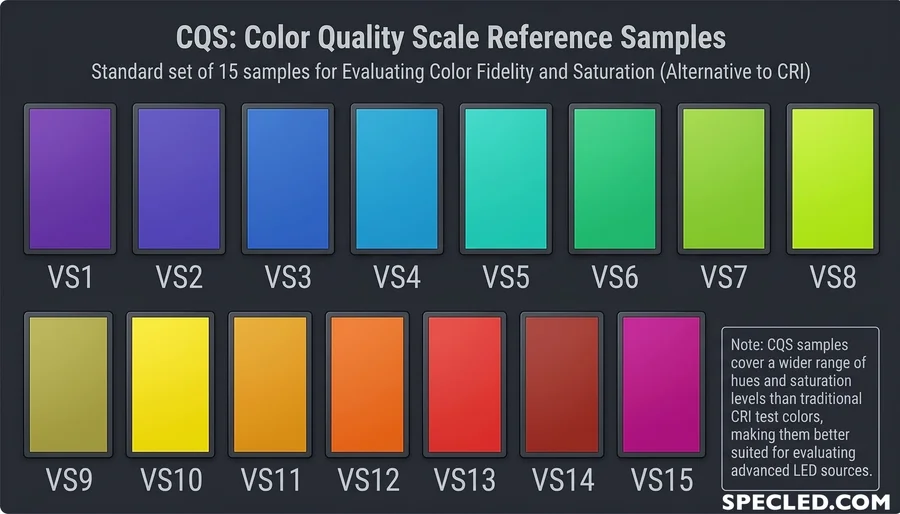
Fig 1. CQS Color Quality Scale featuring 15 reference colors.
- Mathematical Apparatus: CRI uses the arithmetic mean. CQS employs root mean square (RMS) deviation: $\Delta E_{RMS} = \sqrt{\frac{1}{15} \sum_{i=1}^{15} \Delta E_i^2}$. Because of this, poor color rendering on even a single hue will sharply lower the overall CQS score, making it impossible to hide spectral flaws.
- Attitude Toward Saturation: CRI heavily penalizes a light source if it makes colors more vibrant. CQS accounts for physiology — the human eye prefers a slight oversaturation of objects, so the score is not reduced for this.
How the CQS Scale Works
The CQS evaluation scale has a classic range of 0 to 100 points. However, unlike the flat CRI, it provides developers with a three-dimensional understanding of light quality by breaking down the final result into three sub-metrics:
- Qa (Color Quality): An overall integral quality score that accounts for both technical accuracy and the aesthetic appeal of the light.
- Qf (Color Fidelity): The accuracy index (strict mathematical correspondence to a reference source).
- Qg (Color Gamut): The color gamut index (a measure of saturation and the visual volume of illuminated objects).
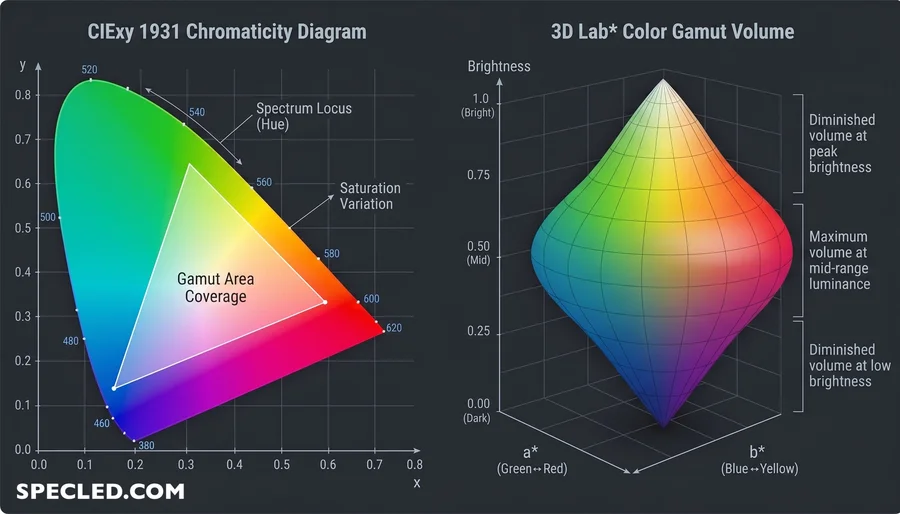
Fig 2. Three-dimensional comparison of the Color Gamut area.
The Future of CQS LED Technologies
Although this standard was technically superior to the CRI baseline, it was never officially approved by the CIE (International Commission on Illumination) as a global standard, giving way to an even more complex color rendering evaluation system, TM-30. Nevertheless, CQS is still used in metrics to assess LED light quality. The CQS standard has been integrated into spectrophotometer software by practically all leading global photometric equipment manufacturers, such as Ocean Optics and UPRtek.
If you need to evaluate the color rendering of a light source using the CQS, CRI, or TM-30 metrics based on an image of its spectrum, you can use our LED spectrum digitizer↗ to extract data from an image or a datasheet screenshot of a spectrogram.
The CQS index is, in fact, a simpler yet more elegant and accurate scale for evaluating color rendering than the obsolete CRI scale. Moreover, it was the history of CQS's creation that paved the way for today's most advanced global color rendering standard — IES TM-30 (introduced in 2015), which adopted the CQS concept of using saturated colors and analyzing human preference.
As far as I know, there is no law obliging manufacturers of consumer LED equipment to indicate the color rendering index of their products according to the CQS or TM-30 standards. Most manufacturers still indicate the Ra index (Ra > 80) in their documentation or packaging, which, as we have already discovered, means very little in the LED world.
You should not ignore light quality, especially in the workplace and when working with small details. For example, to easily decipher a modern resistor color code↗ without making a mistake, the color rendering index really should be at least 80 units, and preferably measured on the CQS or TM-30 scale. High-quality industrial and domestic lighting is, above all, the key to the health of your eyes and affects your level of physical and psycho-emotional stress.
In today's world, increasing attention is being devoted to circadian lighting and the impact of light on melatonin. To evaluate lighting quality, you can use the melanopic EDI calculator↗.
I highly recommend always checking the product you buy and using only high-quality LED lighting fixtures.