How Does the Color Rendering Index of LED Lamps Affect Human Eyes?
With the global shift towards energy-saving technologies, classic light sources have rapidly become a thing of the past, giving way to light-emitting diodes (LEDs). However, along with the undeniable energy savings, consumers, lighting designers, and engineers face a natural and crucial question: are these new technologies safe for our vision and overall well-being? On the global internet, search queries like why do led lights flicker and what is color rendering index take top positions on specialized forums. Such queries emerged with the massive introduction of household LED lamps into our daily lives.
The fact is that poor-quality artificial lighting can not only distort the visual perception of surrounding spaces, furniture, and food but also cause chronic migraines, reduce concentration, and lead to rapid and painful visual fatigue. To understand the true nature of this phenomenon, protect your vision, and learn how to choose truly safe light, it is necessary to dive deep into spectral characteristics, study the long evolution of color assessment metrics, and understand the physics of the flicker factor.
From Incandescent Lamps to White LEDs: The Physics of Light and Incandescent Lamp CRI
Before the mass appearance of LEDs, humanity used incandescent and halogen lamps for many decades. From a fundamental physics perspective, they represent what is called an "absolutely black body," where a tungsten filament is heated to extremely high temperatures. Thanks to this physical process, the incandescent lamp CRI is always close to 100 units, just like the sun. Its emission spectrum is absolutely continuous, smooth, and has no sharp breaks or unnatural peaks, exactly replicating the curve of natural sunlight at sunset or sunrise. That is why under the warm light of an old incandescent bulb, our eyes feel maximally relaxed, and the colors of objects in the room are rendered with minimal distortion.
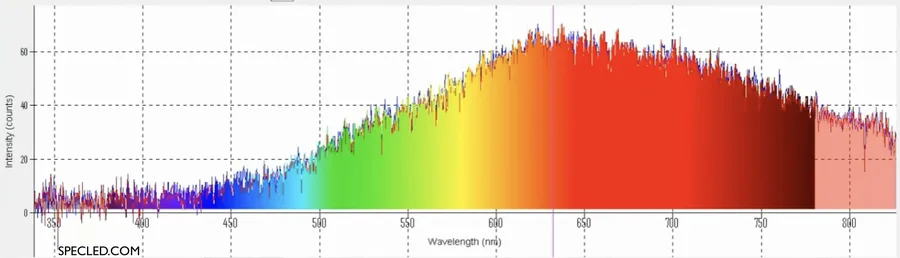
When the first generations of white LEDs entered the commercial market, the situation changed dramatically. It is important to understand that a white LED is essentially a powerful blue crystal (emitting in the 440-460 nm range) coated with a layer of special yellow phosphor. Because of this design, the spectrum of cheap LED lamps always features a huge "Blue Peak" and catastrophic dips in the turquoise and deep red areas. It is this harsh spectral imbalance that causes the human eye to experience excessive physiological stress on photoreceptors and the ciliary muscle, constantly trying to subconsciously "fill in" the missing shades, which in the long run causes tangible harm to the visual system.
This means that LED lamps with a low CRI coefficient are not recommended for use in residential areas.
What is the Color Rendering Index (CRI) and Why CRI Evaluation is Outdated
Color rendering is the ability of a light source or technical device (screen, printer, camera) to accurately reproduce the natural colors of objects.
Color rendering accuracy is of paramount importance in any environment where hue identification can affect perception, for example, on retail floors, in museum exhibits, and medical facilities.
To evaluate the quality of artificial light, the color rendering index (CRI or Ra) is historically used. This indicator was developed by the International Commission on Illumination (CIE) in the last century and is measured on a scale from 0 to 100. The higher this indicator, the more natural colors look under a given light source. The sun is the reference light source, so the CRI of the sun is 100.
The problem with the classic CRI standard lies in its hopelessly outdated testing methodology. The evaluation of a light source using the Ra system is conducted on only 8 pale, unsaturated pastel color samples (from R1 to R8). This basic set completely lacks the bright, saturated colors that we encounter every day. Manufacturers of cheap white LEDs quickly realized this vulnerability: they learned to adjust the chemical composition of the yellow phosphor so that the lamp shines perfectly precisely in these eight pastel spectra, receiving a high final score (e.g., 80 or 85), while heavily distorting the rest of the colors.
This phenomenon in the professional lighting environment is called "hacking" or "cheat-coding" the CRI index. Manufacturers have indeed learned to manipulate the imperfections of the old testing standard to sell cheap lamps under the guise of high-quality ones.
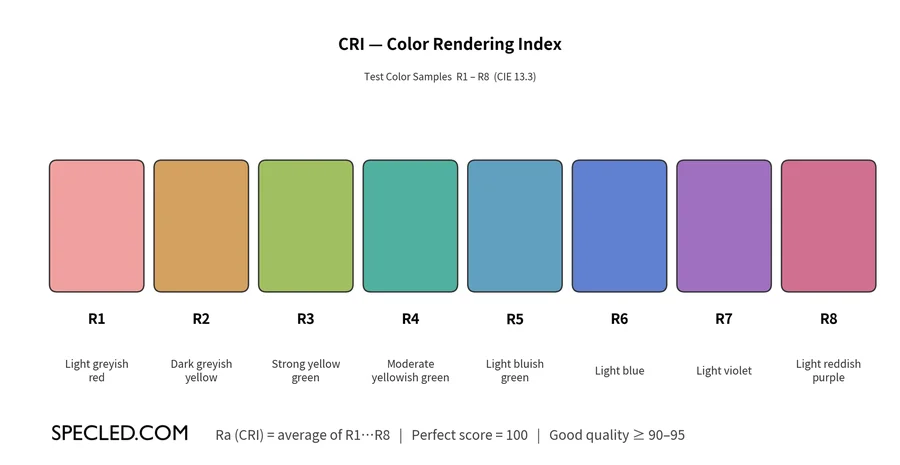
To solve this problem, 7 additional test colors (from R9 to R15) were created, which are not included in the standard Ra calculation.
Critically Important Parameter R9 (Deep Red)
The biggest problem with the old CRI standard is the ignorance of the R9 color (deep red). This color is critically important for lighting, as it is abundantly present in human skin tones, red fruits, vegetables, meat, and wooden furniture. A cheap LED lamp may have a stated color rendering index of ra 80, but its R9 indicator may be negative (for example, -20).
Under such light, people's faces look sickly pale, grayish, or greenish, and products in the kitchen or supermarket lose all their appeal. In premium lighting for medicine, art galleries, and food retail, the R9 parameter must always be above 50, and ideally strive towards 90.
Understanding the Significance of Color Rendering Index Measurements
The Color Rendering Index (CRI) quantifies the accuracy with which a given light source reproduces the spectral characteristics of an illuminated object compared to a specified reference illumination, usually idealized sunlight. This assessment is based on a cardinal scoring system from 0 to 100, where increasing scores correspond to a more accurate color reproduction. The index was formalized in the 1960s by the International Commission on Illumination (CIE) and subsequently endorsed as an internationally standardized tool for assessing light quality. In the field of lighting engineering, CRI quickly established itself as a normative standard, especially in areas such as retail, fine arts, and clinical practice, where accurate color rendering is a discrete or implicit evaluative imperative.
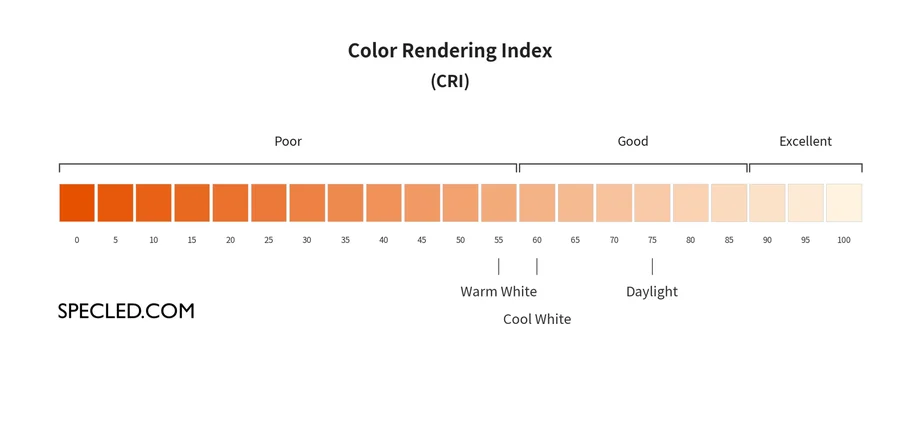
The Color Rendering Index (CRI) determination protocol establishes a comparison between the color perception of eight standard color samples, chosen to cover the entire color gamut, under a potential source and under a corresponding spectral reference sharing the same color temperature as that source. The methodology derives a series of chromatic deviations, which are then moderated into an average asymmetric metric. Optimal performance, denoted by an index of 100, characterizes a situation in which the deviations under the potential source coincide with the deviations under the reference. However, the index is implicitly limited by its reliance on eight pastel samples, which collectively ignore the appearance of highly unsaturated or particularly bright colors. This shortcoming led to the emergence of modifications, such as CQS or the more qualitative TM-30 metric, which simultaneously preserves the legacy of CRI and expands the evaluation framework across an extended color palette.
Lighting with a high color rendering index CRI > 90 or higher, provides numerous measurable benefits:
- High color rendering accuracy occurs when a color rendering index of at least 90 minimizes distortion in the perception of hue, color, and texture, which is especially important in spaces such as art galleries, photo studios, and retail displays in high-end stores, where accurate reproduction of the original color is of paramount importance.
- Reduction of visual fatigue: lighting systems designed for accurate color rendering reduce the discrepancy between visual memory and stimulus, thereby reducing eye strain and increasing comfort in conditions requiring constant observation, for example, in laboratories, precision manufacturing, working with small parts, or clinical diagnostics.
- Improved spatial aesthetics: luminaires with an elevated color rendering index give rooms a sense of dynamism and warmth, making walls, furniture, and architectural details more attractive.
- Increased work efficiency: in professional fields—graphic design, digital color grading, or radiography—accurate color rendering is a prerequisite for precision. Consequently, environments equipped with high color rendering index sources ensure higher productivity and lower error rates.
By implementing lighting with a high color rendering index, one can create environments that combine functional rigor with perceptual enrichment, increase the comfort of work performed under high-quality light, and thereby increase worker productivity and reduce their final fatigue.
From my own experience, I can say that lighting with a CRI index of 98 really reduces eye fatigue and significantly increases comfort while working with small details or working at a computer. Since 2019, I have been using lamps assembled with SunLike SMD3030 LEDs with a color temperature of 5000K to illuminate workspaces.
Color Quality Scale (CQS): An Expanded View of Color Saturation
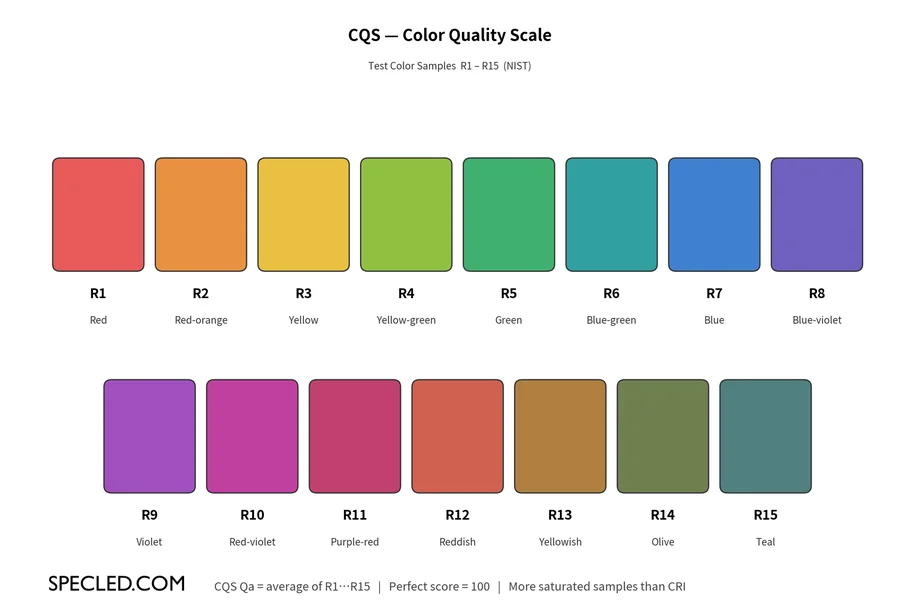
To close a huge gap in light quality testing, researchers from the US National Institute of Standards and Technology (NIST) developed an alternative, more modern standard — the Color Quality Scale (CQS).
Unlike basic CRI, the CQS scale evaluates a light source across 15 deeply saturated colors chosen to evenly cover the entire visible spectrum. If an LED lamp has dips in the red, deep blue, or emerald spectrum, its CQS score drops instantly. The CQS scale has become a crucial tool for professional lighting designers because it honestly reflects how saturated, vibrant, and bright objects will look in real life. Lamps with high CQS do not just illuminate a space; they make it visually richer. I discussed the standard in more detail in the article: CQS Color Rendering Index↗.
The New TM-30 Standard. How Does TM-30 Improve Color Rendering Assessment?
TM-30 (more precisely IES TM-30) is a modern two-component standard and method for assessing the color rendering of light sources, developed by the Illuminating Engineering Society of North America (IES) to replace the outdated CRI index.
Unlike the one-dimensional CRI scale, which evaluates light using just a single number, the TM-30 standard provides a volumetric assessment of light quality using two main indices, Rf and Rg, and detailed vector graphics.
TM-30 (Technical Memorandum 30) is an innovation in lighting engineering, completely abandoning the primitive assessment of light with a single digit. Instead of 8 unsaturated CRI samples, the TM-30 metric analyzes light across 99 real color patterns. These patterns are taken not from abstract mathematical calculations, but from real physical life: skin colors of representatives of different nations, wood, foliage, fabrics, plastic, and paints.
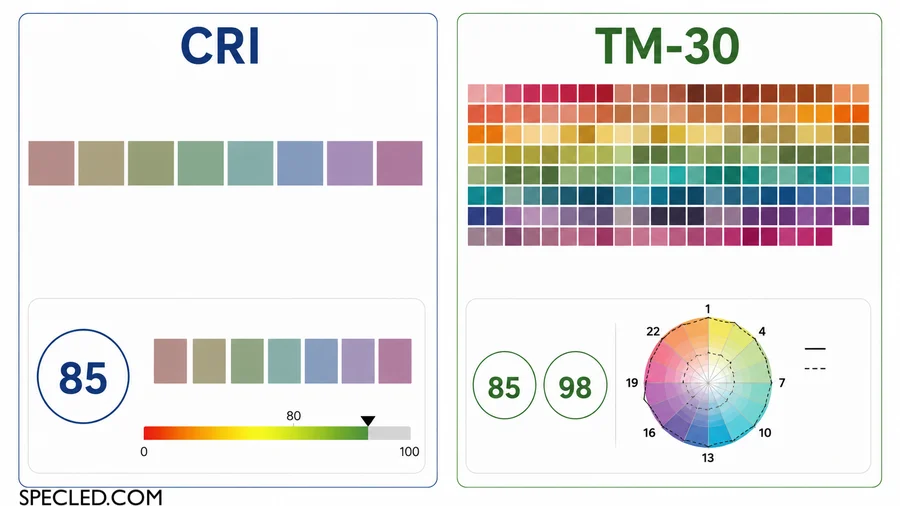
TM-30 divides its rigorous assessment into two fundamental indices, providing comprehensive information:
- Fidelity Index (Rf). This parameter shows how closely the color of an object under the tested light mathematically matches its color under a reference solar emission. This is a direct, but much stricter and more accurate analog of the classic color rendering index due to the massive statistical sample of 99 colors.
- Gamut Index (Rg). This is a completely new, breakthrough metric that shows whether a lamp makes colors duller, grayer, and lifeless (Rg < 100) or, conversely, oversaturates them, making them unnaturally bright and "screaming" (Rg > 100). An ideal light source has an Rg of exactly 100.
But the main technological advantage of TM-30 lies in the generation of "Color Vector Graphics". This is a detailed circular diagram on which an engineer immediately visually sees exactly in which spectral region the distortion occurs. For example, a graph can show that a lamp perfectly renders blue and green shades, but heavily distorts and desaturates warm reds and oranges. Such deep and uncompromising analytics leave manufacturers of cheap components no chance to hide the defects of their products.
Lighting Design in Practice: Why TM-30 is Chosen
The discrepancy between the CRI color rendering index and TM-30 is not merely formal, nor is it just a different sample; the discrepancy has practical consequences in the field of lighting design. Firstly, TM-30 provides a higher accuracy of color rendering, allowing professionals to guarantee uniform color reproduction in applications where color accuracy is critical, for example, in retail, healthcare, or museum settings. Secondly, having indices for both color fidelity and saturation opens up design possibilities not available when using the color rendering index (CRI). Thus, lighting professionals can select or tune light sources not only to reproduce the correct hue but also to enhance color saturation to create vibrant merchandise displays or to maintain the muted tonality of a naturally lit space.
- Better suited for LEDs: TM-30 inherently accounts for the spectral and emission features specific to LEDs, so the light quality assessment is more accurate and modern. CRI, on the other hand, was created for incandescent lamps and worse reflects the behavior of today's solid-state sources.
- Convenient charts for decision-making: TM-30 provides visual tools—color vector diagrams and charts of fidelity and saturation shifts. From these, it is immediately apparent how the color of objects will change, allowing one to more accurately fine-tune the spectrum of a luminaire, with almost no room for misinterpretation.
While CRI still serves as a preliminary selection indicator, TM-30 provides the necessary spectral detail and multidimensional accuracy assessment required for high-precision LED applications and complex, color-critical environments.
However, the majority of LED lighting manufacturers, especially for household bulbs with E27, E14 bases and residential fixtures, are in no hurry to switch to the TM-30 color rendering evaluation index, as they will lose heavily in marketing; tweaking the phosphor to achieve a high index on the CRI scale will no longer work here.
The second point is the more complex chart; most people choosing bulbs do not look at the Ra parameter at all, or do not even know what it means. If such products were labeled according to the TM-30 scale with two separate indices, Rf and Rg, the situation would become even worse, and the buyer might get completely confused. Therefore, CRI is still relevant in everyday life, while the professional environment is increasingly shifting towards using the TM-30 standard.
Below is a comparative table of the two standards: CRI (Ra) and TM-30
| Parameter | CRI (Ra) | TM-30 |
|---|---|---|
| Number of Color Samples | Only 8 samples in pastel tones | 99 samples — both muted and saturated colors |
| Metrics Provided | One overall fidelity score (from 0 to 100) | Two separate indices: fidelity (Rf) and saturation/gamut (Rg) |
| Saturation Assessment | Color saturation is not considered | Shows how much brighter or paler colors become (Rg index) |
| Visual Tools | Charts are not provided | Features color vector diagrams and hue shift charts |
| Relevance for Modern Sources | Created for incandescent lamps and older technologies | Originally designed for LEDs and OLEDs |
| When to Apply | Quick overall assessment of lighting quality | Detailed analysis where accurate color rendering is critical |
What Range of Color Rendering Index Can Be Expected From LED Light Sources?
The modern global semiconductor market offers an incredibly wide range of solutions, the quality range of which directly depends on the complexity of the chemical composition of the applied phosphor and the overall cost of the technologies used.
In the ultra-budget segment, intended for street lights, car park illumination, industrial workshops, or warehouses, diodes with a CRI of around 70 units on the CRI scale are used. For such specific tasks, energy efficiency (maximum number of lumens per consumed watt) is solely critical, while accurate shade rendering takes a back seat.
In the mass consumer segment, the de facto standard for LED lamps has long been CRI 80. This threshold is strictly regulated by European and international building standards for residential spaces, office buildings, and schools. Values from 80 to 85 are quite sufficient for comfortable execution of basic daily tasks (cleaning, cooking, moving around the building); however, for prolonged reading, sewing, or computer graphics work, this quality is no longer enough.
We created a specialized tool↗ to digitize and analyze LED spectra and obtain data such as CQS and TM-30. Its purpose is to digitize a light source's spectrum from an image and calculate the fundamental metrics.
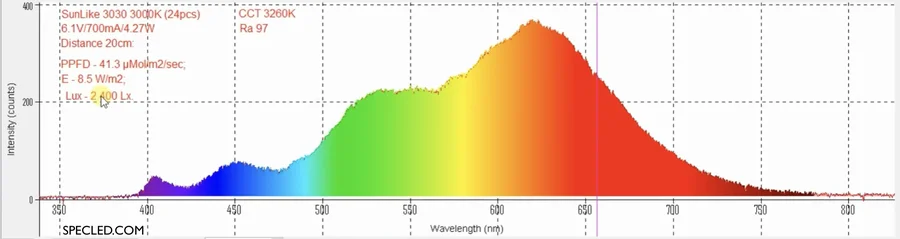
The premium segment and specialized optics confidently demonstrate scores of 90 to 98 CRI. Such outstanding values are achieved through the use of innovative multi-component phosphors and complex technologies. For example, SunLike series LEDs use a violet crystal instead of a standard blue one, the powerful emission of which is converted by a special three-component RGB phosphor. This technological solution makes it possible to obtain a practically perfectly flat spectral curve that visually and biologically does not differ from real sunlight. Such high-tech sources are expectedly noticeably more expensive, but they are absolutely and undeniably necessary in dentistry, surgical operating rooms, art galleries, photo studios, and elite clothing boutiques, where the slightest error in color perception is completely unacceptable.
Below is an example of a spectrum measured on our laboratory test bench for a SunLike LED with a color temperature of 3000K.
The Duv Parameter and MacAdam Steps (SDCM)
Two other key metrics are closely related to the color rendering parameter: Duv and MacAdam ellipses. These metrics make it possible to compare light sources with the same color temperature and color rendering index with each other.
Duv is a metric that defines the magnitude and direction of a white light source's color shift from the black-body curve (Planckian locus) on the CIE 1976 color diagram. The light can shift towards a greenish or pinkish tint while still maintaining a high level of color rendering.
A MacAdam ellipse is a region on the color diagram within which the human eye is unable to perceive a difference in color between two light sources. All colors falling within a single ellipse are perceived by an average person as an absolutely identical shade.
High-quality lighting equipment will always have a deviation of no more than 2–3 MacAdam steps (SDCM).
We have compiled more detailed information about MacAdam steps and Duv in a separate article featuring an interactive widget↗ and a mini-game to interactively explain the values of these two important metrics.
What is the Color Rendering of LED Strips?
The color rendering of LED strips is an important parameter, especially when strips are installed in places where colors must look correct: in stores, kitchens, and restaurants. To evaluate how honestly a strip renders colors, two main tools are used — the classic CRI and the more professional TM-30 method. Together, they provide a much fuller picture than CRI alone, helping you correctly choose a strip for a specific task.
Unfortunately, the color rendering of LED strips in practice is a serious problem. Most, especially inexpensive Chinese LED strips, have very poor color rendering — their CRI index often drops to 65–70. Under such light, colors look dull, distorted, or "dirty," and practically speaking, such strips are unsuitable for normal work in interior design or commercial projects, yet they are still widely used.
What are the Advantages of Using LEDs with a High Color Rendering Index?
A conscious transition to quality lighting (CRI > 90, and ideally > 95) is not a marketing gimmick, but a basic investment in your own health, occupational safety, and daily psychological comfort. The implementation of such advanced light sources provides a whole range of undeniable and scientifically proven medical benefits:
- Biological Safety and Visual Comfort: A continuous, full spectrum of emission radically minimizes the strain on the complex mechanism of the optic nerve. Your eye no longer needs to compensate for the lamp's spectral gaps every second, which radically reduces overall physical fatigue after many hours of working with documents, prevents evening headaches, and reliably protects vision from early degradation.
- Ideal Architectural Aesthetics of the Space: Interior items, expensive furniture, and textures of finishing materials look maximally volumetric, deep, and natural. Premium-class lighting can visually "warm up" any cold room, spectacularly highlighting expensive wood species, the gleam of metal, and the complex texture of fabrics.
- Psychological Well-being and Mood: Correct rendering of deep red shades (that very high R9 indicator on the CRI scale) makes human skin color look healthy, fresh, and rosy. This directly, on a subconscious level, positively affects our internal mood and empathetic perception of the people around us.
- Uncompromising Professional Accuracy: For surgeons during operations, colorists in auto showrooms, graphic designers at monitors, and agronomists in greenhouses, absolute color rendering accuracy is a mandatory working tool. Only an extremely high index (and high Rf/Rg scores according to the TM-30 standard) guarantees that a specialized professional makes the single correct decision based on visual inspection.
The Biological Impact of Light: Circadian Rhythms and the Harm of the Blue Peak
When discussing the harm of LED lamps to the eyes, one cannot ignore the impact of the spectrum on our circadian rhythms (internal biological clocks). As already mentioned, at the core of cheap white LEDs lies a powerful crystal emitting bright blue light (Blue Hazard).
Numerous medical studies have proven that an excess of the blue spectrum in the evening blocks the production of melatonin — the most important hormone responsible for deep, restorative sleep and the functioning of the immune system. Being under the cold light (5000K-6000K) of cheap LED lamps two hours before bedtime is guaranteed to lead to insomnia, anxiety, and chronic fatigue.
That is why high-quality LEDs with high CRI and the correct color temperature (2700K - 3000K for the evening) have a smoothed blue peak, making the lighting biologically safe and comfortable for human biorhythms.
Specifically for circadian rhythms, the company Luminus developed the Salud series of LEDs. The main goal of Salud is to support human circadian rhythms (alertness and sleep quality) through precise spectrum tuning, without using harsh, uncomfortable blue light.
In some countries, doctors may even prescribe melatonin pills to improve sleep quality. So lighting is not just about comfort; sometimes it can become an unnoticeable, completely invisible problem! The paradox here is that artificial lighting has become a problem with the mass departure from the household of incandescent lamps, whose spectrum is warm and very linear with very insignificant emission in the blue part of the spectrum. Monitor the quality of the lighting you live and work with!
Spectrum Simulation and Illuminance Calculation: Tools for Professionals
In professional design, it is important not only to choose the right source with high CRI but also to competently calculate its physical impact on the workspace. The light should be distributed evenly, without creating sharp shadows and glare, which also tire the eyes.
For these complex purposes, engineers use specialized software. On our website, you can use the interactive illuminance simulator for residential and industrial facilities according to the EN12464 standard↗. This tool helps to perform a preliminary engineering assessment of the required number of luminaires, the required luminous flux, and the uniformity of lighting depending on the type of room (office, workshop, living room). However, our widget does not replace professional simulation programs.
And for those enthusiasts and engineers who construct their own custom premium-class luminaires with perfect color rendering, we have developed a convenient simulator for mixing the spectrum of SunLike LEDs↗. It allows you to virtually combine different LED spectra with different color temperatures to foresee the final spectral curve and color temperature before purchasing real components.
The Hidden Problem: LED Light Source Flicker and Eye Health
Even if you choose the most expensive premium matrix or module with an absolutely perfect continuous spectrum, the light can still cause serious harm to your health due to pulsation (the stroboscopic effect). And exactly this is the answer to a popular question on the foreign internet: why do led lights flicker.
Unlike an old tungsten filament, which has immense thermal inertia and physically does not have time to cool down and dim between the half-cycles of alternating household current (50 Hz), an LED is completely devoid of inertia. It reacts to the slightest change in voltage in a matter of microseconds.
If a lamp manufacturer saved money on the driver (electronic power supply) and failed to install high-quality smoothing capacitors and special chokes, the lamp will mercilessly flicker at a frequency of 100 Hz. This problem is particularly, and quite painfully, characteristic of driverless technologies directly connected to the 220-volt mains. A striking example is the situation with the Acrich technology (AC LED 220V) from Seoul Semiconductor↗. Despite the obvious engineering convenience of the complete absence of a bulky external power supply, such matrices possess a critical and insurmountable flaw — the highest level of flicker, reaching 100% at a frequency of 100 Hz.
Worse still, in modern smart home systems, deep pulsation can arise due to low-frequency pulse-width modulation (PWM), when a microcontroller dims the light by very rapidly turning it on and off to reduce brightness.
Although our brain does not consciously perceive flicker above 60-80 Hz, the retina and optic nerve flawlessly detect these microscopic fluctuations. The pupil is forced to make micro-contractions hundreds of times per second, trying to adapt to the changing luminous flux. This inevitably leads to severe spasms of the eye muscles, dry eye syndrome, a sharp drop in reading concentration, and severe evening migraines. According to strict medical and sanitary standards (e.g., IEEE 1789 standard), a safe flicker factor for workplaces should not exceed 5%, whereas cheap market lamps or AC matrices can output a catastrophic 40% pulsation.
The Phyto-Light Paradox: Color Rendering Index in Lamps for Plant Lighting
Why, one might ask, do plants need a color rendering index; they do not have eyes, and seemingly no nervous system either, yet a high color rendering index is indispensable!
The reasons here are actually more than one and probably fewer than three. This means there are two:
1. A high color rendering index means that the critically important emission range in the red part of the spectrum from 600 to 700nm is completely and qualitatively covered. The spectrum of LEDs with a color rendering index of Ra 95+ is usually slightly wider than standard white LEDs and captures a part of the spectrum around 420nm, which is good for plants. This particularly applies to SunLike series LEDs or Bridgelux Thrive series.
2. The second reason is a consequence of the first. If lamps with a high color rendering index are installed in closed city farms or grow rooms, it becomes much easier for the agronomists servicing such systems to identify and determine emerging plant problems and diseases at early stages. Experienced agronomists immediately notice unnatural changes in the color of plant leaves, yellowing or whitening edges, and small pests. Quick resolution of such problems helps to save or even increase the final harvest. This also applies to standard greenhouses, because on cloudy days or in winter when the day is short, lighting plays a critical role both for plant growth and for human work.
Interactive Comparison of Spectra and Flicker
Understanding and realizing the dry numbers of engineering standards can be quite difficult without visual demonstration. To clearly demonstrate how different CRI and pulsation (flicker) levels radically change your perception of reality and comfort, we have developed a unique interactive widget.
Move the sliders below to see with your own eyes the depressing difference between the dim light of an old sodium lamp (HPS) with a CRI of 20 and a modern premium LED solution with a CRI of 98. Also, using the second slider, you can evaluate the effect of stroboscopic flicker, which so greatly tires our eyes when low-quality drivers are used.
Frequently Asked Questions (FAQ)
Why do cheap LEDs cause eye fatigue? The main reasons lie in the low quality of light. Cheap lamps suffer from two ailments: severe spectral imbalance (excess blue light with an absence of red, resulting in a low CRI) and a high flicker factor due to poor drivers. Combined, these factors force the eye muscles to constantly strain, causing dry eyes and migraines.
Can I measure lamp flicker at home? Yes, a basic check can be done using a smartphone camera. Turn on the lamp and point your camera at it in slow-motion mode (Slow-Mo) or with manual settings for a high shutter speed (1/500 sec and above). If running dark bands appear on the screen, the lamp has a high and unsafe level of flicker.
Does the TM-30 standard replace the familiar CRI? Technically, TM-30 is a much more advanced and precise evolution of the evaluation method, which is gradually displacing CRI in the professional environment of lighting designers and architectural engineers. However, CRI (Ra) remains a widely accepted consumer standard, so manufacturers will continue to indicate it on the packaging of household lamps for a long time. For a deep understanding of light quality, if necessary, it is recommended to request a TM-30 datasheet from the manufacturer.
Does dimming affect the flicker of LED lamps? Very often it does. If a lamp or dimmer uses low-frequency pulse-width modulation (PWM) technology to reduce brightness, then when the light is dimmed (for example, to 30%), the pulsation becomes much more pronounced and aggressive. To create safe dimmable lighting, it is necessary to use specialized drivers with no flicker (Flicker-Free) at any power level.
Is a high CRI needed for street lighting? For lighting highways and industrial areas, a high CRI is not mandatory (Ra 70 is sufficient), as contrast, visibility range, and energy savings are more important there (often LEDs with Ra 70 have a greater green component in the spectrum, which is better perceived by the human eye, meaning such LEDs are brighter to the eye). However, for lighting pedestrian parks, alleys, architectural monuments, and cozy residential areas, a high CRI (>80) makes the space much more comfortable and safer to perceive.
Final Recommendations for Choosing Safe Light
The question of what is color rendering index and why cheap lamps flicker is not just a whim. High-quality light is a direct and crucial investment in your health, visual longevity, and daily productivity!
When switching to modern LEDs, ensure that you choose light sources that not only save electricity but also provide a high color rendering index (CRI > 90, or confirmed fidelity scores according to TM-30) with a confirmed zero flicker factor. Treat light as seriously as you treat the quality of air or water in your home. Only with such a conscious approach will modern solid-state LED technologies bring you exceptional benefits without hidden health risks.