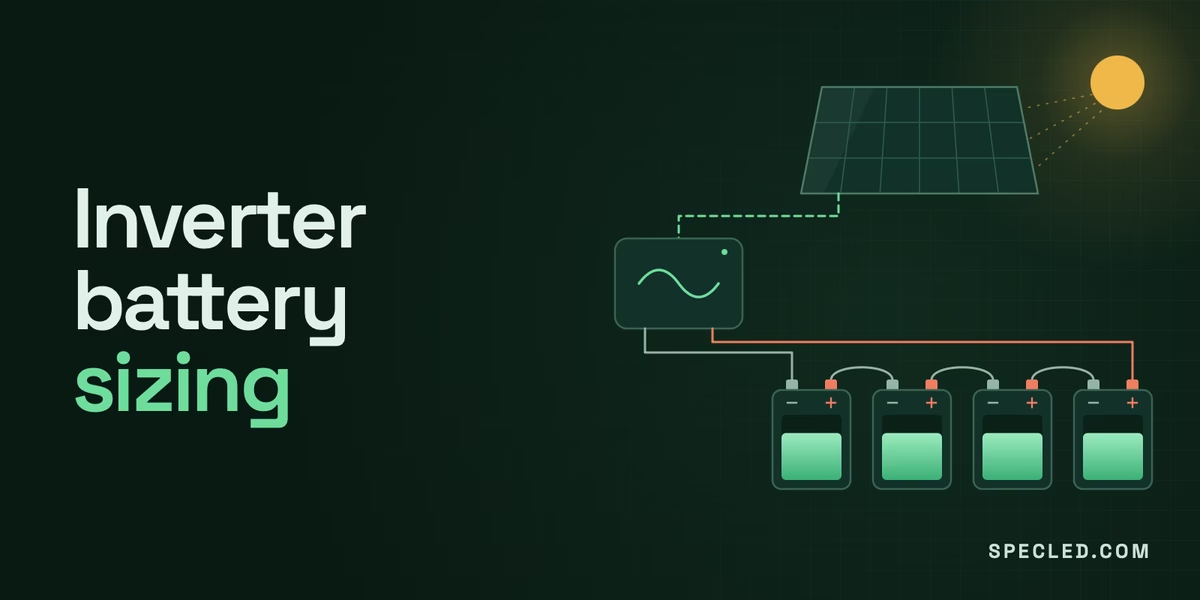
Battery capacity for an inverter and solar panels is calculated based on energy, or in other words, power over time. You need to know how many kilowatt-hours to draw from the battery bank, for how many days, at what temperature, and down to what depth of discharge. Simply dividing consumption watt-hours by capacity significantly underestimates the result because it does not account for inverter efficiency, cold temperatures, discharge rate, and aging.
Below is a description of the methodology used by the "battery capacity calculator" on this page, complete with formulas and worked examples. Calculating a battery bank for a backup power inverter and an off-grid solar power station works the same way; the difference lies in the number of days the battery supports the load on its own. The methodology is based on IEEE 1013-2019 recommendations for standalone photovoltaic systems and the aging margin from IEEE 485.
Input Data
Six values are required to calculate a battery bank for an inverter — all of them are included in the calculator.
- Daily consumption, kWh. The most reliable way is to take meter readings over a week and divide by seven. By appliances — multiply the power rating of each appliance by its daily operating hours and sum them up.
- Peak power, kW: the largest load switched on simultaneously. Maximum load is usually reached during evening hours.
- Days without sun. For a home with grid power or a generator, 1–2 days are usually enough. Calculating battery capacity for solar panels in an off-grid home is done for 3–5 days of cloudy winter weather. Our solar panel calculator↗ will help determine the climatic norms for your region.
- Battery temperature — the lowest possible temperature in the room where they are installed.
- Inverter efficiency (90–95%) and no-load self-consumption. For the 3 and 5 kVA Victron MultiPlus-II↗, self-consumption is 11 W and 18 W; for some budget models, it is noticeably higher. Even 15 W over 24 hours adds up to 0.36 kWh.
- Battery share on a sunny day — what portion of consumption falls on the evening and night. It is not included in the capacity calculation, but it defines the depth of the daily cycle, and therefore the service life.
Battery Capacity Calculation Formula
Calculating battery capacity for an inverter is done in two steps. First, find the energy W that the inverter draws from the battery per day:
W = (E / η + 24 × P₀) / 0.98
Then — the required capacity in ampere-hours:
C = N × W × 1.25 / (V × DoD × kT × kr)
- E — daily load consumption, Wh; η — inverter efficiency; P₀ — inverter self-consumption, W; 0.98 — DC wiring losses.
- N — days without sun; V — nominal battery voltage, V.
- 1.25 — aging margin: according to IEEE 485, a battery has reached the end of its service life when its capacity drops to 80%.
- DoD — allowable depth of discharge: about 80% for LiFePO4, 50% for AGM and GEL, 50–60% for OPzS.
- kT — capacity fraction at the lowest temperature: 0.75–0.85 at 0 °C and 0.45–0.55 at −20 °C.
- kr — discharge rate correction factor. AGM capacity is rated for a 20-hour discharge (C20); over 5 hours, such a battery delivers about 85%. OPzS capacity is rated for 10 hours (C10), and over two days it delivers 20–25% more.
Peak current is checked separately. The calculator sets limits of 0.5C for LiFePO4 and AGM, 0.4C for OPzS, and 0.35C for GEL; if the peak current is higher, the capacity is increased.
Example: Battery Bank Calculation for a Private Home
A house consumes 10 kWh per day, and the battery must power the house for one and a half days without sun. A 48 V LiFePO4 bank (nominal 51.2 V), 80% depth of discharge, and a 5 kW inverter with 93% efficiency and 18 W self-consumption are selected. In winter, the average temperature in the utility room with the batteries is +12 °C.
- Energy drawn from the battery per day: (10,000 / 0.93 + 24 × 18) / 0.98 ≈ 11,410 Wh.
- For one and a half days: 11,410 × 1.5 ≈ 17,120 Wh, or 17,120 / 51.2 ≈ 334 Ah.
- Corrections: aging margin 1.25, depth of discharge 0.8, at +12 °C kT ≈ 0.957, for slow discharge kr = 1.
- C = 334 × 1.25 / (0.8 × 0.957 × 1) ≈ 546 Ah.
The closest bank configuration is two 51.2 V 280 Ah modules in parallel: 560 Ah, or 28.7 kWh. A 5 kW peak draws about 115 A, which is 0.2C — well within normal limits. A naive calculation (10,000 × 1.5 / 51.2 ≈ 293 Ah) would have yielded almost half as much.
On a typical sunny day, when the battery covers half of the consumption, it discharges by approximately 21%. At this depth, LiFePO4 is limited not by cycle life, but by calendar aging: the calculator assumes a 15-year service life for it.
Inverter Runtime Calculation from a Battery
Runtime is calculated using the inverse formula: the capacity is already known, and you need to find out how many hours a load P will last.
t = 0.98 × V × C × DoD × kT × kr / (P / η + P₀)
Example: 12 V 100 Ah AGM battery, 300 W load, inverter with 90% efficiency and 10 W self-consumption, warm room. Power drawn from the battery is 300 / 0.9 + 10 ≈ 343 W, current is about 29 A. At this current, an AGM battery discharges in less than three hours and delivers about 77% of its C20 capacity, and it is best not to discharge it deeper than 50%:
t = 0.98 × 12 × 100 × 0.5 × 1 × 0.77 / 343 ≈ 1.3 h
That is about 1 hour and 20 minutes — three times less than what "1200 Wh / 300 W = 4 hours" suggests. A 12.8 V 100 Ah LiFePO4 battery under the same load will last about 3 hours: it can be discharged by 80%, and its capacity is almost independent of the current.
LiFePO4, AGM, GEL, or OPzS
For daily cycling with solar panels, LiFePO4 is most often chosen: at 80% depth of discharge, it withstands 6,000+ cycles, while AGM lasts about 400.
| Technology | Working Depth of Discharge | Cycle Life at 80% DoD | Main Limitation |
|---|---|---|---|
| LiFePO4 | 80–90% | from 6000 cycles | standard batteries of this type cannot be charged below 0 °C |
| OPzS | 50–60% | 1500 cycles | requires ventilation and water topping up |
| GEL | 50% | 500 cycles | does not tolerate elevated charging voltage |
| AGM | 50% | 400 cycles | service life drops sharply with deep cycles |
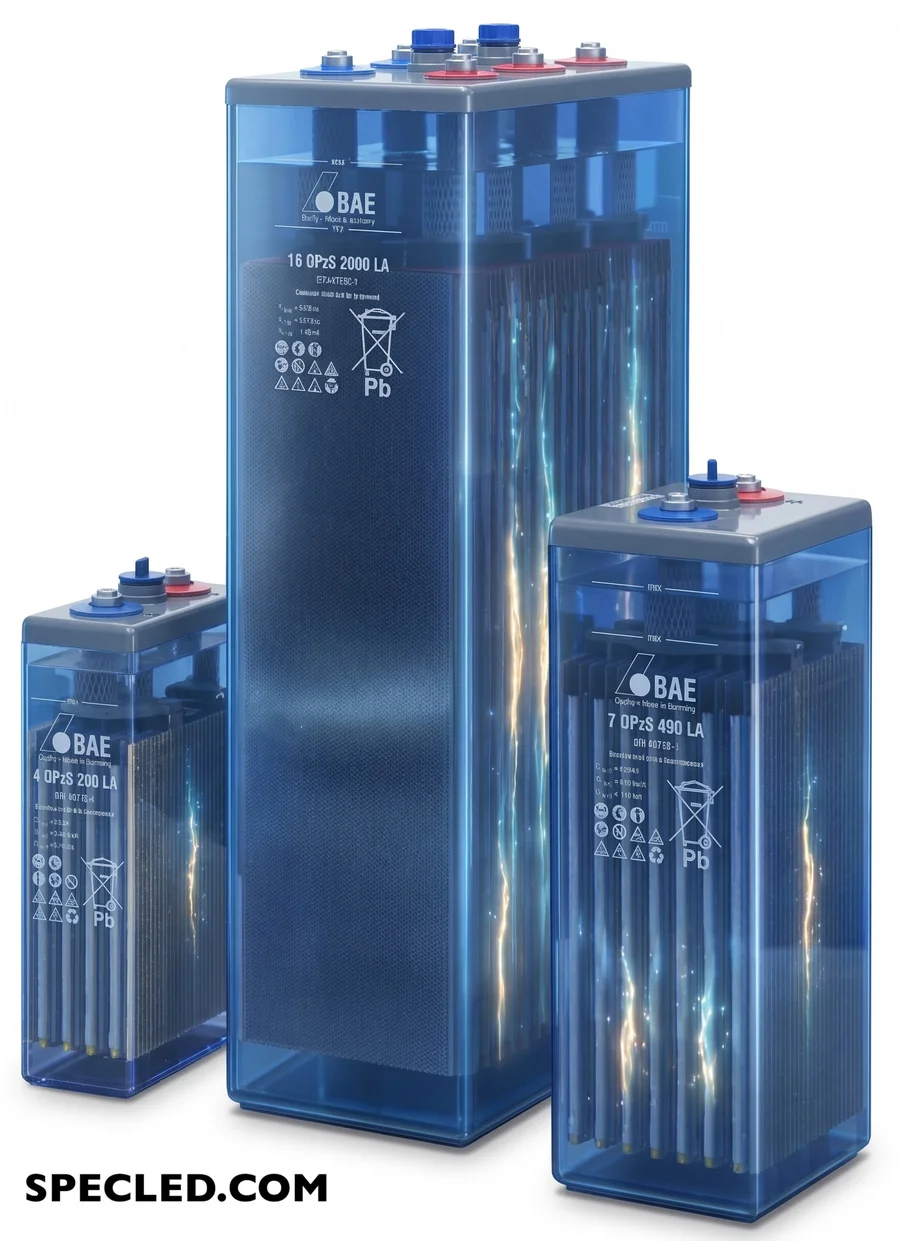
Lead-acid batteries are justified in two cases. AGM is suitable for backup power with rare outages, when the battery remains fully charged almost all the time. OPzS batteries last up to 20 years and are good for off-grid sites where space and a ventilated room are available.
System Voltage and Wiring Configuration
Voltage is selected based on peak power so that the current does not exceed approximately 150 A: 12 V for consumption up to 1.5 kW, 24 V up to 3 kW, and 48 V for higher loads. A 5 kW load at 12 V would require over 400 A, meaning cables with a cross-section greater than 100 mm² and heavy-duty fuses. A 48-volt system is virtually always considered the industry standard. For an accurate cable cross-section calculation, use the wire size calculator by power and current↗.
Series connection increases voltage; parallel connection increases capacity. Four 12 V blocks in series yield 48 V; two such strings in parallel yield twice the ampere-hours.
- Lead-acid batteries are assembled in no more than three parallel strings. Current is divided unevenly between them, causing some batteries to wear out faster. If capacity is insufficient, larger cells are used, such as 2-volt OPzS cells.
- LiFePO4 modules with a built-in BMS are connected in parallel within the limits permitted by the manufacturer.
- Terminals are connected to busbars diagonally: positive from one end of the bank, negative from the other. This ensures all strings are loaded equally.
Cold, Aging, and Service Life
In the cold, a battery delivers less energy: at 0 °C — 75–85% of capacity, at −20 °C — about half. Therefore, the lowest temperature in the room is used in the calculation, rather than the annual average.
For lead-acid batteries, frost also poses the danger of electrolyte freezing, and the deeper the discharge, the sooner this happens. A fully charged battery withstands temperatures below −50 °C, at 40% state of charge it freezes at around −15 °C, and at 20% — at around −7 °C. LiFePO4 can be discharged in freezing temperatures, but cannot be charged below 0 °C, so an insulated cabinet or heated modules are required in winter. There are also LiFePO4 batteries with improved electrolyte that allow charging at temperatures down to −20 °C, but the price of this type of battery is significantly higher.
Service life is the lesser of two factors: cycle life and calendar aging. Cycle life depends heavily on the depth of daily discharge: AGM withstands about 1,500 cycles at 30% DoD and only 600 at 50%. If such a battery is discharged halfway every day, it will last less than two years.
Heat also shortens battery service life. For lead-acid batteries, service life drops by roughly half for every 10 °C above 20 °C, while for EVE LF280K LiFePO4 cells, cycle life at 45 °C is 2,500 cycles compared to 6,000 at 25 °C.
Given these temperature factors, batteries should be installed in a heated, dry room.
Do not forget about safety! Choose your protective circuit breakers properly. For this purpose, we created a widget called "how to choose a circuit breaker↗". The article below the widget explains in detail the principles behind the calculation.
Common Mistakes When Calculating a Battery Bank for an Inverter
- Failing to account for inverter efficiency and self-consumption. These consume 7–12% of energy plus hundreds of watt-hours per day.
- Assuming the entire capacity is usable. For lead-acid batteries, the working depth of discharge is around 50%.
- Taking the label capacity without checking the rating: C20 for AGM and C10 for OPzS represent different conditions, and under fast discharge, a battery delivers less.
- Using the average annual temperature in calculations instead of the lowest temperature.
- Assembling many parallel strings of lead-acid batteries instead of a single string of larger cells.
- Omitting the aging margin and ending up a few years later with a battery that cannot last through the night.